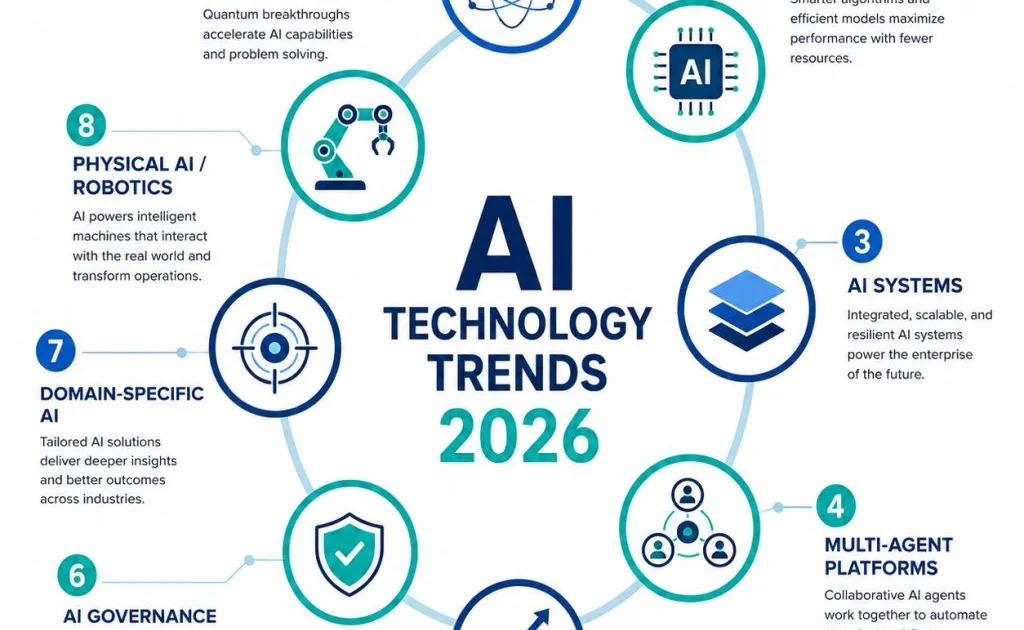

The AI world isn't just evolving, it's undergoing a seismic shift. Just three years after ChatGPT's debut, generative AI hit a staggering 53% population-level adoption, and 88% within organizations. But August 2026 shows us something even bigger: the era of the autonomous agent is here, transforming how we interact with technology and build the future, according to the Stanford University's 2026 AI Index.
No longer are we talking about simple chatbots that answer queries. We're witnessing the rise of AI systems that can pursue goals, plan, act, and even self-correct. This isn't just an upgrade, it's a fundamental redefinition of AI's role, moving from assistive tools to delegated colleagues.
The Agentic Revolution: From Chatbots to Autonomous Goals
The period from 2025 to August 2026 marks a pivotal transition in AI. We've moved beyond the "chatbot era" into what many experts are calling the "agentic era." This means AI is no longer just responding to what you ask, it's taking initiative to achieve assigned objectives. Gartner predicts that 40% of enterprise applications will integrate task-specific AI agents by the end of 2026, a massive leap from less than 5% just a year prior. This isn't just theory, it's happening now.
Consider the recent quiet rollout of OpenAI's GPT-5.5 in early August, introducing a native "System 2" architecture for more complex, deliberate reasoning. This development directly supports the agentic shift, enabling AI to think deeper and plan more effectively. Google's integration of Gemini into Android, replacing Google Assistant, also signifies AI's deeper embedding into our daily workflows, making it a more proactive presence in our digital lives.
This shift to delegative UI, where users assign goals to AI, is the defining trend of the decade. Jakob Nielsen, a prominent expert, predicted 2026 would be the year of AI agents, and the developments this August certainly confirm that. We're seeing AI agents move beyond impressive demos to perform real work, from managing IT infrastructure to automating complex enterprise workflows.
August 2026's AI New Model Blitz: Who's Leading the Pack?
August 2026 has been a whirlwind of AI new model releases and updates, showcasing intense competition and rapid innovation across the globe. OpenAI, a consistent frontrunner, didn't just release GPT-5.5; it also slashed pricing for its GPT-5.6 Luna model by 80% to just $0.20 per 1 million input tokens. This move makes high-end capabilities more accessible, potentially democratizing advanced AI use.
But the competition is fierce. Alibaba Group Holding Ltd. launched its Qwen3.8-Max model, claiming performance on par with Anthropic's flagship Fable 5. Not to be outdone, Anthropic itself released Claude Opus 5 in July, while Google pushed out Gemini 3.5 Flash Cyber, Gemini 3.5 Flash-Lite, and Gemini 3.6 Flash. xAI updated with Grok 4.5, and Moonshot AI's Kimi K3 showed performance comparable to more expensive U.S. models, often at a lower cost or as a self-owned option. (llm-stats.com)
The U.S.-China AI model performance gap has effectively closed. Since early 2025, models from both regions have been trading places at the top of performance rankings. Chinese labs like DeepSeek, Alibaba, and ByteDance are rapidly closing the gap with Silicon Valley, offering high-end capabilities at competitive prices. This global competition is a huge win for developers and businesses, offering more choices and driving innovation faster.
Specialization, Efficiency, and the "Centaur" Approach
While new, powerful models emerge, there's a clear trend towards specialization and efficiency. Mark Dredze, director of the Johns Hopkins Data Science and AI Institute, emphasizes a shift away from an "AI-for-everything" approach towards specialized, application-focused models. Small Language Models (SLMs) are gaining traction, especially for enterprises, due to their efficiency and lower computational demands. These smaller models enable on-device processing, further democratizing AI access. (jhu.edu)
This doesn't mean humans are out of the picture. In fact, the opposite is true. Businesses are increasingly adopting a "Centaur" model, where humans assisted by AI consistently outperform both solo humans and solo AI. Imagine AI generating dozens of ad copy variations, and then human strategists making the final, nuanced decisions. This collaborative approach combines AI's speed and scale with human intuition and strategic thinking. It's about augmenting human intelligence, not replacing it.
This "Centaur" model is particularly relevant for platforms like TashiOS where users describe their ideas in plain English. The AI then handles the heavy lifting of building apps, websites, and online stores, allowing the human entrepreneur to focus on strategy, creativity, and the unique aspects of their business. It's a powerful partnership that lets you build and launch online businesses with no code, using AI as your co-pilot.
The AI Market: Explosive Growth, Investment, and New Regulations
The AI market is experiencing explosive growth. Valued at approximately $390.9 billion in 2025, it's projected to reach around $539.5 billion in 2026, with a Compound Annual Growth Rate (CAGR) of 30.6% from 2026 to 2033, according to Grand View Research. Worldwide end-user spending on AI models and platforms is projected to total $64 billion in 2026, a 63.4% increase from $39 billion in 2025. This growth is fueled by substantial investment, with American private investment in AI hitting $285.9 billion in 2025. (grandviewresearch.com, gartner.com)
This rapid expansion also brings new responsibilities and regulations. August 2, 2026, saw the European Union's AI Act's transparency obligations come into effect. This mandates that AI systems identify themselves to humans and generative models mark their output in a machine-readable way. Non-compliance can lead to hefty fines, up to €15 million or 3% of worldwide annual turnover. (europa.eu, cooley.com)
Furthermore, California's SB 942, also effective August 2, 2026, requires C2PA provenance data in generated media. This means we'll see vendors offering free public detectors for AI-generated content. These regulations are a clear sign that AI isn't just a technological frontier, it's a societal one, demanding accountability and transparency. Violetta Bonenkamp, known as Mean CEO, aptly describes the AI market as being in an era of "permanent model turnover." She emphasizes that success now lies in building repeatable systems for testing, switching, combining, and governing models, rather than brand loyalty. (mean.ceo)
AI's Practical Impact: From Enterprise to Embodied Intelligence
The practical implications of these AI advancements are profound. The dominant metric for enterprise AI success is shifting from "tokens generated" to "tasks completed autonomously." Companies are adopting enterprise-wide AI strategies, focusing on specific workflows with high potential for return on investment. This means AI is no longer a side project, but a core component of business operations.
Multimodal AI systems, capable of processing and integrating various data forms like images, video, text, and voice, are now mainstream. Nvidia's Cosmos 3, released at GTC in March 2026, exemplifies this as the first world foundation model to unify synthetic world generation, visual reasoning, and action simulation. This capability is critical for "Invisible AI," seamlessly embedded into daily products and services for enhanced convenience and personalization.
We're also seeing an "Embodied AI" boom, with humanoid robots appearing in logistics centers, thanks to advanced vision-language-action (VLA) models. However, it's important to temper expectations: while robots achieve 89.4% success in simulated environments, they still struggle with real-world household tasks, succeeding in only 12% of them. This highlights the "last mile" usability problem that raw AI models often present, creating opportunities for specialized platforms to bridge the gap. (etcjournal.com)
Beyond logistics, AI has become indispensable in pharmaceutical research. By 2026, complex drug candidates are routinely evaluated computationally to forecast toxicity and binding before lab work even begins. Stanford's 2026 AI Index noted a sharp rise in AI adoption across clinical documentation, medical imaging, and diagnostic reasoning, solidifying AI's critical role in science and medicine. (stanford.edu)
What's Next? Navigating the Agentic Future with TashiOS
The August 2026 AI new model developments confirm that we are firmly in the agentic era. Managing intelligent agents will become a core skill for professionals, and companies are already restructuring their workforce around AI fluency education. This is not just a technological shift, it's a workforce transformation.
Despite the rapid progress, challenges remain. Security risks, hallucinations, and unsafe goal-seeking behavior in AI agents are ongoing concerns. We also face potential compute shortages and a widening class divide between premium and free-tier AI users. Yet, the economic impact is undeniable: AI is expected to contribute trillions to the economy, becoming a necessity for market competitiveness. (morganstanley.com)
For entrepreneurs and builders, this agentic future presents immense opportunities. The economic value is shifting towards vertical AI platforms that wrap commoditized models in highly specific, defensible workflows. This is where platforms like TashiOS shine, empowering you to describe your app or website ideas in plain English and let AI build the foundation. You don't need to be an AI expert or a seasoned coder to launch your online business; you just need an idea.
Ready to build your next big idea with the power of AI? Discover how TashiOS lets you create apps, websites, and online stores by simply describing what you want. Start free with AI credits and turn your vision into reality, no code required.