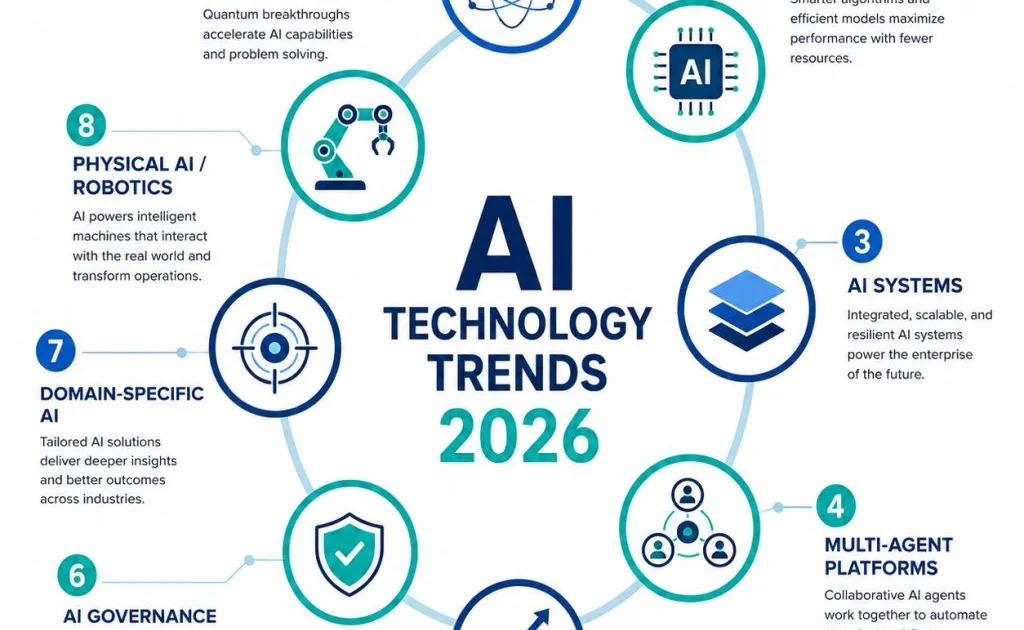

Imagine building a sophisticated AI-powered application in hours, not months, and running it at a fraction of yesterday's cost. This isn't a distant dream for 2030. It's the reality of 2026, thanks to a profound shift in artificial intelligence.
The era of 'bigger is always better' for AI models is over. We're now witnessing a pivot towards smaller, smarter, and incredibly efficient AI. This change is disrupting the no-code development world in ways we've only just begun to understand, making advanced AI accessibility a new standard.
The 'Bigger is Better' Myth: Why 2026 Changes Everything
For years, the narrative around AI development centered on scale. The larger the model, the more complex the tasks it could handle. However, 2026 marks a significant pivot, moving away from this paradigm towards a focus on AI model efficiency.
This shift isn't just theoretical. It's driven by tangible benefits in cost, speed, and practicality. The capabilities equivalent to a model like GPT-4, which cost around $30 per million tokens in early 2023, are now available for under $1 per million tokens. That's a tenfold decrease in inference costs per year for the same performance level (llm-stats.com).
This dramatic cost reduction fundamentally changes the economic landscape for AI. It makes powerful AI accessible to businesses of all sizes, not just tech giants. As Manash Pratim, PhD, aptly stated in December 2025, "Small models are not weak. They are under-estimated," highlighting their potential for fast, cheap, and private AI systems (towardsai.net).
The Tech Behind the Shift: Making AI Compact and Powerful
This revolution in AI model efficiency doesn't happen by magic. It's fueled by advanced model compression techniques that are becoming standard practice. Methods like pruning, quantization, distillation, and low-rank factorization are crucial.
These techniques reduce model size, improve inference speed, and lower energy consumption. They're essential for deploying AI on edge hardware, mobile devices, and low-cost servers, vastly expanding AI's reach beyond traditional data centers.
We're seeing groundbreaking developments in this area. IBM's ZipNN, launched in July 2025, is a lossless compression technique that can reduce neural network model size by over 33%, and sometimes more than 50% (ibm.com). This innovation could potentially save an ExaByte of network traffic annually from large model hubs like Hugging Face.
Even more recently, MIT's CompreSSM, accepted at the International Conference on Learning Representations 2026, offers a new technique for in-training compression of state-space models (mit.edu). Antonio Orvieto, a principal investigator at the ELLIS Institute Tübingen, noted that CompreSSM "opens new avenues for future research, and the proposed algorithm has the potential to become a standard approach when pre-training large SSM-based models" (marktechpost.com).
These advancements aren't just about performance. They also address a growing concern for sustainability. Smaller, more efficient models reduce the computational resources and energy required, aligning with the increasing priority of 'Green AI'. This makes sustainable AI development a practical reality.
No-Code's AI Revolution: Accessibility, Speed, and Savings
The rise of compact AI is a perfect match for the explosive growth of no-code AI platforms. This synergy is democratizing AI development like never before. The global no-code AI platform market, valued at $6.56 billion in 2025, is projected to reach $8.6 billion in 2026, and an impressive $75.14 billion by 2034, demonstrating a compound annual growth rate (CAGR) of 31.13% (fortunebusinessinsights.com, straitsresearch.com).
This exponential growth isn't surprising. No-code platforms drastically reduce the barriers to entry for AI innovation. They allow 'citizen developers', non-technical users, to build and deploy sophisticated AI solutions. In fact, 63% of AI app builder users are already non-developers (thenoah.ai).
The benefits are clear: no-code platforms can reduce development time by up to 90% and cut development costs by up to 70% compared to traditional methods (simplyask.ai, okoone.com). Organizations implementing no-code solutions experience an average 362% ROI, with some achieving payback in less than six months (hostinger.com). These businesses report average annual savings of $187,000 using no-code platforms (hostinger.com).
Platforms like TashiOS are at the forefront of this movement. By describing ideas in plain English, users can build real apps, websites, online stores, and Android apps, then go live and earn. TashiOS makes advanced AI accessible for every entrepreneur, enabling them to capitalize on these AI development trends without needing to write a single line of code.
Real-World Impact: Businesses Thriving with Compact AI
The impact of smaller, smarter AI models combined with no-code tools is already being felt across various industries. These aren't just theoretical gains; they are driving real business value.
Consider the Kobe Municipal Government, which successfully implemented a low-code workflow using Microsoft Power Apps and AI Builder's Form Processing model. This allowed them to process applications in hours instead of days, drastically reducing manual data entry and error rates without requiring custom machine learning expertise (technologychecker.io).
In New Zealand, Autohive, a spinoff of Raygun, offers a no-code AI automation platform built on Amazon Bedrock. It enables small and medium businesses to create AI agents for tasks like customer support, marketing, and analytics, integrating with popular tools such as Slack and HubSpot (amazon.com).
Even tech giants are seeing the value. NVIDIA utilized AI to streamline asset discovery and generate 3D models, converting 2D product images into high-quality 3D models within minutes at a cost of less than $1 per model (nvidia.com). Google, as of early 2025, reported that 25% of its code is AI-assisted, significantly boosting engineering velocity (createbytes.com). Google also offers no-code solutions like Vertex AI's AutoML and the free, browser-based Teachable Machine.
The market is rich with no-code AI tools. Companies like LaunchLemonade and Sintra AI offer AI agent builders. Lindy AI, Make, Zapier, and Microsoft Power Automate provide powerful no-code workflow automation (launchlemonade.app, adalo.com, weweb.io, nocode.tech). Popular no-code app builders like Bubble, Adalo, Glide, and FlutterFlow integrate AI capabilities, making sophisticated development achievable for anyone.
The Rise of Agentic AI: Smart Assistants for Every Task
One of the most exciting AI predictions for 2026 is the mainstream adoption of agentic AI. By the end of 2026, 40% of enterprise applications are predicted to integrate task-specific AI agents, a significant leap from less than 5% in 2025 (sqmagazine.co.uk).
These AI agents are more than just chatbots. They can autonomously plan, make decisions, and execute multi-step workflows across various systems. The efficiency of compact AI models is critical here, enabling these specialized agents to be deployed cost-effectively and at scale.
The market for AI agents is booming, projected to grow from $7.84 billion in 2025 to $52.62 billion by 2030 (grandviewresearch.com). This growth is largely thanks to the ability to create highly specialized, efficient agents for specific tasks, rather than relying on one-size-fits-all solutions.
No-code platforms are empowering this agentic AI revolution. Tools like LaunchLemonade, Sintra AI, Lindy AI, Make, Zapier, Voiceflow, and Botpress allow users to build and deploy complex AI agents without needing deep coding knowledge. This means more businesses can automate intricate processes and free up human talent for higher-value work.
Sustainable AI and Future Predictions for No-Code
The future of AI development isn't about a single, massive model dominating the scene. Instead, we're moving towards hybrid AI ecosystems. This approach involves orchestrating models of different sizes, each optimized for specific tasks, to achieve the best balance of performance and efficiency.
This shift also strongly supports the demand for sustainable and edge AI. Smaller models are ideal for running locally on devices, reducing cloud dependency, latency, and overall energy consumption. This 'Green AI' approach aligns with growing environmental priorities and provides faster, more reliable performance in localized applications.
While AI spending is increasing, a significant portion, around 40% of enterprise AI investments, currently yields less than 10% ROI (marketscale.com, thenoah.ai). No-code platforms, with their visual verification, built-in cost controls, and measurable workflows, offer a structural advantage. They help organizations achieve better returns by preventing expensive mistakes and focusing on practical, high-impact use cases like document triage and data entry.
Finally, AI governance is transitioning from a 'nice-to-have' to an essential enterprise requirement. With regulations like the EU AI Act becoming fully applicable in August 2026, how AI models are developed and deployed is under increasing scrutiny. Efficient, compact models can be easier to manage, audit, and ensure compliance, making governance a more straightforward process.
Platforms like TashiOS are uniquely positioned to benefit from this shift, making it easier for users to build and manage these hybrid, sustainable, and compliant AI solutions. They embody the future of AI development trends.
The narrative of AI is changing. The future isn't just about raw computational power, but about intelligent efficiency. Smaller, smarter AI models are democratizing innovation, making advanced capabilities available to everyone, not just tech giants. This is the promise of no-code AI, and it's here now. Ready to turn your ideas into reality?
Discover how TashiOS empowers you to build apps, websites, and online businesses with the power of AI and no code. Start free with AI credits today and join the future of efficient, accessible AI development.