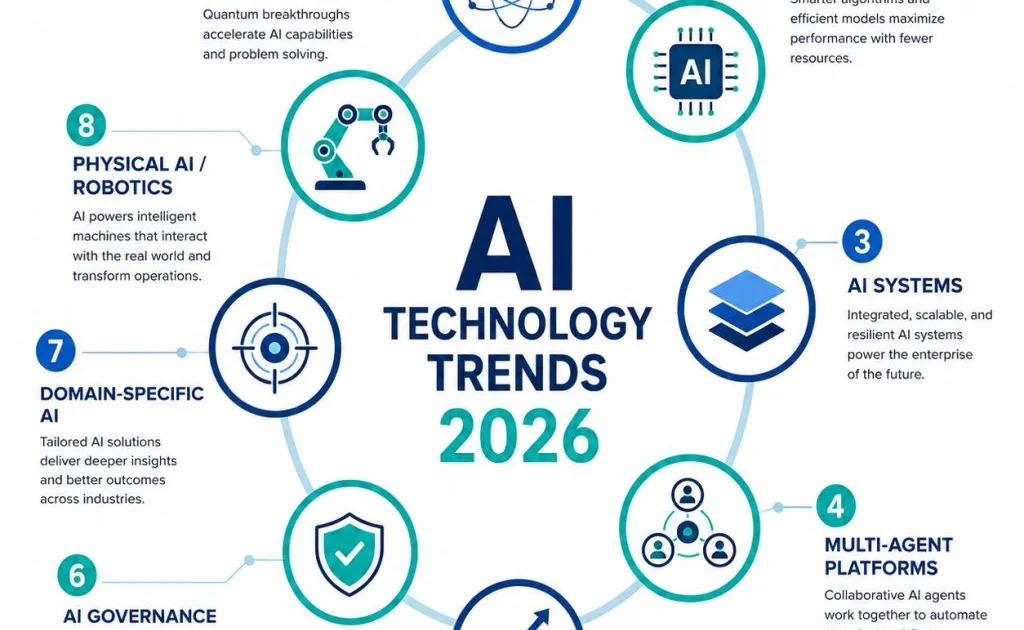

It's official. Generative AI has become the fastest technology category to surpass $67 billion in revenue. This isn't just a trend anymore; it's a fundamental shift in how business gets done. March 2026 has been a whirlwind of new models, massive hardware investments, and a clear move towards practical, money-making applications. So, what actually happened, and what does it mean for you?
The New Class of AI Models: Bigger, Faster, Smarter
The arms race for the most capable AI model is accelerating. This month, we saw major releases that pushed the boundaries of reasoning, context, and interaction, making previous versions feel almost quaint.
Key Model Releases in March 2026:
- OpenAI's GPT-5.4: Launched on March 5th, GPT-5.4 and its Pro version now feature a massive 1-million-token context window. This allows them to process and remember information equivalent to a large novel in a single prompt. They also introduced an extreme reasoning mode and native computer control for agents.
- Anthropic's Claude Opus 4.6: Anthropic's latest model introduces "adaptive thinking". This lets the AI decide when a problem requires deeper, more complex reasoning without needing a user to specify it. Developers also get new controls to balance cost, speed, and intelligence.
- Google's Gemini 3.1 Pro: Positioned as the "efficiency champion", Gemini 3.1 Pro is making waves. Apple is even integrating Google's massive 1.2 trillion parameter Gemini model into Siri for its iOS 26.4 update, bringing on-screen awareness and cross-app actions to millions of users.
These models aren't just incremental updates. They represent a significant step up in capability, particularly in handling complex, multi-step tasks that require a deep understanding of context.
Beyond Generation: The Rise of Agentic AI
Perhaps the most significant development in the AI field is the shift from generative AI to agentic AI. While generative AI is great at creating content, agentic AI can reason, plan, and take autonomous actions to complete goals.
This isn't just theory. It's happening now. Microsoft introduced Copilot Coworkan enterprise agent that can read, analyze, and manipulate files for workers. Startups are also getting in on the action. Basis, an agentic accounting platform that handles audits and tax prep, just reached a $1.15 billion valuation. This move from simply answering questions to actively performing tasks is what's driving real business value.
As Shannon Bell, CIO at OpenText, puts it, the role of tech leaders is changing from running AI experiments to "orchestrating and governing outcomes for the enterprise." Agents are the key to those outcomes.
The Trillion-Dollar Backbone: AI Hardware and Infrastructure
These powerful new AI systems require an incredible amount of computing power, and the industry is spending accordingly. Global corporate AI infrastructure spending has already exceeded $380 billion in 2026, with some projections putting the total market at $1.37 trillion.
Here are the highlights:
- Nvidia's Vera Platform: Nvidia unveiled its "Vera Rubin" platform with H300 GPUs built for trillion-parameter models. On March 16th, it also launched the NVIDIA Vera CPUa processor purpose-built for agentic AI that delivers results with twice the efficiency of traditional CPUs.
- AMD and Edge AI: AMD is pushing AI to local devices with its Ryzen AI 400 series processors. These chips have Neural Processing Units (NPUs) that accelerate AI tasks on your laptop, improving privacy and speed. Valentyn Kropov of N-iX notes that this kind of Edge AI is a "capability shift that legacy architectures can't match."
- Hyperscaler Spending: Companies like Meta, Microsoft, and Alphabet are expected to spend around $600 billion on AI infrastructure this year alone, according to Morgan Stanley Research. Meta is even developing four new generations of its own custom AI chips to reduce its reliance on Nvidia.
This massive investment shows that the world's biggest tech companies are betting their futures on AI dominance.
AI in the Enterprise: From Pilot to Profit
For years, businesses have been running AI pilot programs. Now, the focus is squarely on production and ROI. A remarkable 72% of enterprises worldwide have deployed AI in at least one business function, a huge jump from just 20% in 2017.
Companies are no longer satisfied with flashy demos. They are embedding AI into their core operations to see real financial gains. The partnership between Accenture and Databricks, announced on March 17th, is a perfect example. They've formed a new business group specifically to help organizations scale their AI applications and agents.
However, the demand for results is fierce. Forrester estimates that 25% of planned AI spending may be deferred if companies can't prove a clear return on investment. This pressure is forcing a focus on practical applications that solve real problems, which is where specialized tools shine. Platforms like BuildEZ.ai are a great example, applying powerful AI to a specific, high-value business need like creating a professional web presence without the high cost or complexity.
Putting AI to Work: The New Rules of the Game
The AI developments in March 2026 confirm one thing: AI is no longer a speculative technology. It's a practical tool that's being integrated into every part of our digital lives, from the Siri on our phones to the accounting software that runs our businesses.
The shift to powerful, agentic systems means that complex tasks are becoming more automated and accessible. Building a business, launching a brand, and creating a production-ready website are no longer gated by technical expertise. With the right AI tools, anyone can bring their ideas to life. That's the real power of the AI revolution, and it's already here.