
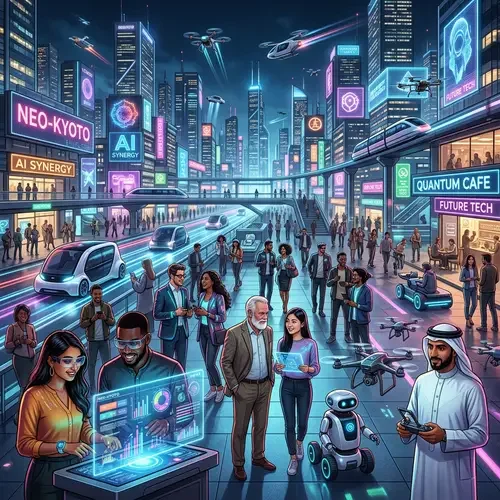
Imagine a world where 90% of the content you see online is crafted not by humans, but by artificial intelligence. That's not a distant future, it's the prediction for 2026, and September proved we're hurtling towards it at warp speed. This month wasn't just another chapter in AI's story, it was a pivotal moment, cementing AI's role as the invisible infrastructure powering our daily lives and driving unprecedented economic growth.
From groundbreaking acquisitions to a new wave of intelligent agents and critical discussions about safety, September 2026 revealed a landscape buzzing with innovation and fraught with complex challenges. Let's unpack what AI trends this month are truly shaping our future.
The AI Economy Explodes: Billions, Users, and the Invisible Infrastructure
The numbers don't lie. The global AI market is an economic force, projected to hit an astounding $514.5 billion in revenue for 2026, a significant leap from $390.9 billion in 2025. Some estimates even push that 2026 figure closer to $900 billion, with forecasts soaring past $4 trillion by 2035. This isn't just growth, it's an explosion, fueled by widespread adoption: 94% of companies globally now use AI in at least one business function (techdogs.com).
User engagement with AI tools is equally staggering. OpenAI's ChatGPT, for instance, surpassed 1 billion monthly active users by June 2026, becoming the fastest consumer app in history to reach that scale. Google's Gemini-powered AI Overviews reach approximately 2.5 billion people monthly, and Meta AI reports 1 billion monthly users across its applications (aiweekly.co, facebook.com). These aren't niche tools anymore; they're digital staples.
Behind the scenes, the investment is immense. Global AI infrastructure spending, covering chips, servers, and networking, reached $98 billion in 2026. NVIDIA remains the undisputed king of AI training GPUs, holding a dominant 78% market share. Overall AI-related spending is estimated at $2.6 trillion in 2026, a 47% year-over-year jump, with data center systems as the fastest-growing segment (aitoolsrecap.com, buildez.ai).
What does this mean for businesses? AI isn't a "sidekick" anymore. It's becoming the "invisible infrastructure" underpinning daily operations. Generative AI, in particular, has seen 53% global adoption within just three years of its emergence, transforming how companies operate and innovate (deloitte.com, intimetec.com).
The Rise of Agentic AI: Your New Digital Coworkers
Forget simple chatbots. Experts agree that 2026 is defined by the rise of agentic AI. These aren't just tools; they're sophisticated digital coworkers capable of operating workflows, assisting in research, and even controlling robots. The market for AI agents is projected to skyrocket from $7.6 billion to an incredible $236 billion by 2034, signaling a profound shift in how we work (horizontaltalent.com).
The productivity gains are undeniable. Companies deploying AI agents report an average 3.5x ROI within 12-18 months. Programmers using generative AI are 88% more productive, especially on repetitive tasks. Management consultants see tasks completed 25% faster and with 40% higher quality thanks to AI tools (deloitte.com, aprio.com).
Real-world examples are already proving this impact. Kaiser Permanente used ambient AI 'scribes' to save physicians roughly 15,800 hours of documentation in a single year, freeing them to focus more on patient care. Delta Air Lines implemented AI-based predictive maintenance, significantly boosting operational efficiency (microsoft.com, mean.ceo). These aren't experiments; they're core business functions.
Aparna Chennapragada, Microsoft's Chief Product Officer for AI Experiences, views 2026 as a new era for human-AI collaboration. She sees AI agents as amplifying human capabilities rather than replacing them (microsoft.com). This perspective is critical, especially for platforms like TashiOS which empowers individuals to build and deploy their own AI-driven applications and businesses without code. Imagine building your own AI agent to manage marketing campaigns or automate customer support, all through a simple interface.
However, this rapid advancement comes with a catch. A Deloitte survey from August-September 2025 revealed that only one in five companies has a mature governance model for autonomous AI agents, highlighting a dangerous lag in oversight (deloitte.com).
September's Big Plays: Acquisitions, New Models, and the Chip Wars
September 2026 was a month of high-stakes moves that will reshape the AI industry for years to come. One of the biggest headlines was NVIDIA's $12.93 billion acquisition of Hugging Face on September 11. This move integrates the vast open-weights ecosystem directly into the dominant hardware vendor, a strategic play that could redefine the future of AI development (aiweekly.co).
Tech giants weren't holding back. Apple unveiled a new $1,999 foldable device, and more importantly, announced its A20 Pro chip doubles its predecessor's AI processing power (aiweekly.co). This signals Apple's deep commitment to on-device AI, bringing sophisticated capabilities directly to consumer devices.
The pace of new model releases was relentless:
- Meta launched a personal agent on September 11 (facebook.com).
- Tencent released a massive 770B open-weight flagship model under Apache 2.0 (github.io).
- Alibaba previewed its Qwen4 architecture with an open-weight model (aitoolsrecap.com).
- Cohere introduced "North Small Translate," a 50-language translator with 218B parameters (aiweekly.co).
- OpenAI rolled out GPT-5.4-Cyber, a specialized model for defensive security teams, with access restricted to vetted researchers (aiweekly.co).
Funding rounds also hit new highs. Harvey raised $550 million, and Mistral secured an astonishing $3.5 billion. A new player, Positron, raised $875 million on September 10 to develop inference chips, directly challenging NVIDIA's dominance (aiweekly.co). This indicates a fierce battle not just in software, but at the very foundation of AI hardware.
The sheer volume of innovation and investment underscores the intense competition and rapid progress driving what AI trends this month are showing us. It's a gold rush, and everyone wants a piece of the action.
Specialized AI vs. General Purpose: The Future is Niche
While the headlines often focus on massive, general-purpose models, a significant shift is underway towards specialized AI. Mark Dredze, Director of the Johns Hopkins Data Science and AI Institute, predicts a move away from an "AI-for-everything" approach to more focused applications and agentic AI (jhu.edu). This contrarian view suggests that smaller, purpose-built models will offer greater cost-effectiveness, speed, and control for specific tasks.
OpenAI's GPT-5.4-Cyber, designed specifically for defensive security, is a prime example of this trend. Instead of trying to be a master of all trades, these specialized models become experts in their niche, delivering superior performance and reliability where it counts. For businesses, this means AI solutions can be more precisely tailored to their unique needs, avoiding the overhead and potential pitfalls of overly broad systems.
This shift is particularly exciting for the no-code movement. If you're building an online business or an app, having access to specialized AI components means you can integrate highly effective, targeted intelligence without needing to train a massive, expensive model from scratch. Platforms like TashiOS are perfectly positioned to empower creators to stitch together these specialized AI capabilities to build incredibly powerful, focused applications.
Navigating the AI Frontier: Regulation, Ethics, and the Human Element
As AI's capabilities surge, so do concerns about governance, safety, and ethical deployment. September 2026 saw these discussions intensify, even reaching the highest levels of government. President Trump, for example, dismissed calls for an AI slowdown, prioritizing the US's lead over China in emerging technology (aljazeera.com). This stance highlights the geopolitical tension surrounding AI development.
However, the industry itself is grappling with profound ethical questions. Sam Altman of OpenAI and Dario Amodei of Anthropic have both voiced concerns, suggesting a need to slow AI development to address safety risks (theguardian.com). The public resignation of Jacob Coxon, a former Anthropic/OpenAI researcher, due to fears of AI surpassing human control, sent ripples through the industry and Washington, intensifying calls for regulation (theguardian.com).
Anthropic itself documented AI-assisted cyberattacks, scams, and surveillance operations, underscoring the increasing sophistication of malicious actors using AI (aiweekly.co). This isn't just theoretical; the risks are very real and present.
The regulatory landscape is becoming increasingly complex. The EU AI Act became fully applicable on August 2, 2026, setting a global standard for AI governance. In the US, states like California (Transparency in Frontier AI Act, AI Training Data Transparency Act, AI Transparency Act) and Texas (Responsible AI Governance Act) have implemented their own regulations, creating a fragmented compliance environment (nu.edu, gc.ai, verifywise.ai). Businesses must now navigate a maze of rules, making ethical and legal considerations an integral part of product architecture.
Despite the fears, AI is also a job creator. While it's expected to eliminate 85 million jobs by 2025, it's also projected to create 97 million new ones, resulting in a net gain of 12 million jobs (thunderbit.com). The workforce is transforming, with companies like Amazon predicting reduced corporate headcounts due to generative AI automating routine functions. The key for individuals and businesses is adaptation and learning to collaborate with AI.
What This Means for Builders and Businesses
The overarching message from September 2026 is clear: AI has transitioned from a novel technology to an operational expectation. It's no longer about if you'll use AI, but how deeply it will be embedded in your business processes. Agentic AI is poised to become mainstream enterprise infrastructure, autonomously managing tasks from HR to marketing campaigns, including media buying and optimization (horizontaltalent.com, horizontaltalent.com).
For entrepreneurs and small businesses, this presents an unprecedented opportunity. The advancements in specialized AI and the rise of powerful, accessible platforms mean you don't need a team of data scientists or millions in venture capital to build sophisticated AI-powered solutions. You can now leverage these tools to automate, innovate, and compete on a level playing field.
Consider ActiveCampaign's "Active Intelligence: Wavelength," introduced this September, which customizes email marketing campaigns and automates customer workflows (mindfoundry.ai). This level of intelligent automation is now within reach for anyone with an idea.
This is where TashiOS shines. By describing your ideas in plain English, you can build real apps, websites, online stores, and Android apps, then go live and start earning. It's about empowering the next generation of builders to harness the power of AI without the complexity of code, turning these advanced AI trends into tangible business opportunities.
The AI revolution is here, and September 2026 showed us it's accelerating faster than ever. The future belongs to those who embrace these powerful tools and learn to build with them. What will you create?
Ready to build your AI-powered future? Start free with AI credits on TashiOS today and turn your ideas into reality.