Imagine a world where building a professional website takes minutes, not weeks. A world where you describe your vision in plain English, and AI brings it to life. This isn't a futuristic fantasy; it's the reality of AI web design in October 2026. What's truly surprising? While 85% of designers knew AI would be essential, by this month, a staggering 93% of web designers are actively using AI tools in their daily workflows, according to Visme data. This isn't just experimentation; it's normal production work.
AI has moved beyond being a helpful assistant. It's now a full-fledged collaborator, fundamentally reshaping user expectations and website functionality. The focus is clear: speed, usability, and personalization are non-negotiable. This shift isn't just for tech giants; it's empowering individuals and small businesses to build online presences with unprecedented ease and efficiency.
The AI Web Design Market Explodes: Numbers Don't Lie
The growth of AI-powered website builders is nothing short of phenomenal. In 2025, the global market was valued at approximately USD 2.69 billion. By the end of 2026, it's projected to reach USD 3.24 billion, marking a significant 20% year-over-year increase. This trajectory is set to continue, with projections soaring to USD 17.43 billion by 2035, representing a compound annual growth rate (CAGR) of 20.55% from 2026-2035, as reported by Precedence Research.
The United States market alone is expected to grow substantially, reaching nearly USD 5.69 billion by 2035. This rapid expansion underscores a fundamental shift in how websites are created and managed. Cloud-based (SaaS) tools are leading the charge, accounting for approximately 81% of the AI-powered website builder market share, making accessibility and scalability easier than ever.
Small businesses are at the forefront of this adoption wave. A remarkable 58% of small businesses now use generative AI, a significant jump from just 23% in 2023. This shows a clear recognition of AI's power to level the playing field, allowing smaller entities to compete with larger ones in the digital arena.
AI as Your Creative Co-Pilot: From Busywork to Brilliance
The idea that AI will replace human designers has largely been debunked. Instead, experts emphasize that AI enhances, rather than replaces, human creativity. AI excels at production work: generating wireframes, exploring layout variants, and drafting initial copy. These are the administrative tasks that used to consume valuable design time.
By October 2026, 91% of surveyed designers are using AI at least weekly, with 75% engaging with it daily. This isn't occasional use; it's ingrained in their routine, freeing them to focus on what humans do best: brand nuance, strategic decisions, and compelling storytelling, as highlighted by Agency Partner.
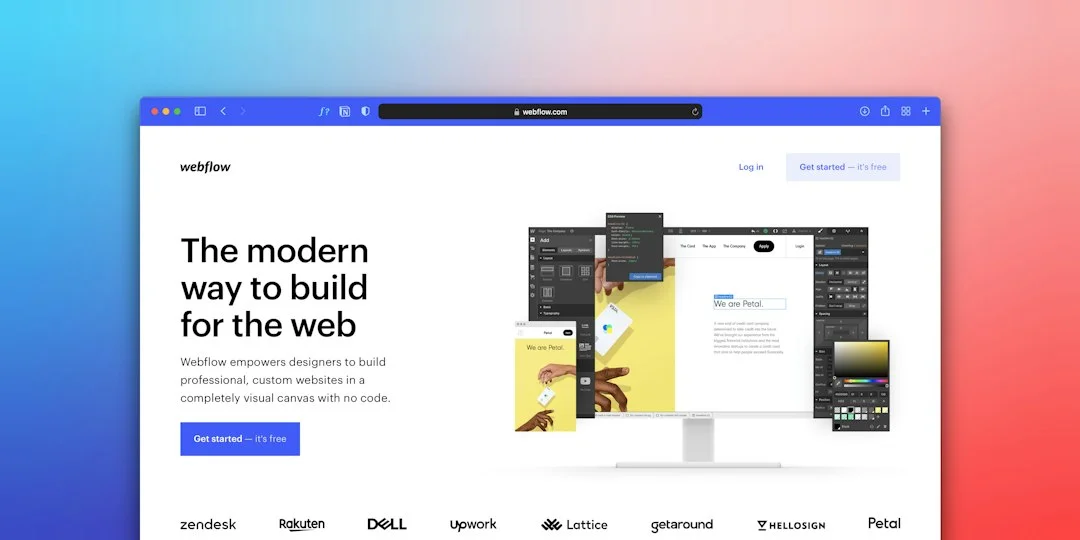
Consider tools like Figma AI, which offers AI-powered features for visual design and prototyping directly within its platform. Webflow AI generates multi-page responsive websites from descriptions and helps with design modifications and content generation. Uizard, another AI-powered UI/UX design tool, generates mockups from text descriptions. Relume is widely used for wireframing and planning, streamlining the initial stages of design.
AI has become a full-time collaborator, handling the tedious aspects of design so human designers can elevate their strategic and creative input. This collaboration leads to faster iterations, more informed decisions, and ultimately, better websites.
Beyond Simple Prompts: Agentic AI and Vibe Coding Redefine Creation
The evolution of AI in web design has introduced concepts that move far beyond simple text-to-image or text-to-code generation. We're now seeing the rise of "agentic AI," where AI systems execute complex, multi-step tasks within website workflows.
Elementor's agentic AI framework, Angie, is a prime example. Operating within WordPress, Angie performs complex tasks automatically, building components and taking action directly within the dashboard, not just providing code snippets, according to Elementor. Similarly, Cisco Webex AI Agents now participate in meetings and perform multi-step work across applications, showcasing the increasing sophistication of AI autonomy.
Another groundbreaking development is "vibe coding." This method allows AI tools to generate code from natural language descriptions, enabling creators to focus on their vision rather than syntax. Platforms like TashiOS exemplify this, allowing users to describe their ideas in plain English to build real apps, websites, online stores, and Android apps without manual coding. This approach truly delivers on the promise of no-code development, making professional-grade web creation accessible to everyone.
Other notable tools in this space include v0 by Vercel, which turns interface ideas into shippable code, and Bolt.new, a code generation tool that achieved an astonishing $40 million in annual recurring revenue (ARR) within just six months of launch. These tools illustrate how AI is accelerating development cycles and empowering even non-technical users to bring complex digital products to life.
The New Frontier: Hyper-Personalization and Immersive Experiences
Websites in October 2026 are not static brochures. They are dynamic, intelligent entities that adapt to each visitor. Hyper-personalization is a defining trend, with websites adjusting content and layouts in real time based on user behavior, preferences, and past interactions. This creates a deeply engaging and relevant experience for every individual.
Voice search optimization is no longer a niche concern; it's projected to influence 30% of web traffic in 2026, as per Yacss.site. This means designers must now consider different content structures and conversational language to cater to voice queries, transforming it into a critical design task.
Immersive experiences are also gaining traction, particularly in e-commerce. Websites are leveraging 3D visuals and augmented reality (AR) to enhance product presentation. Sites with 3D product visualization see conversion lifts of up to 40%. AR is projected to drive $6 billion in e-commerce sales in 2026, making it a powerful tool for engaging customers and boosting sales, Yacss.site reports. Tools like Spline AI can even generate interactive, web-ready 3D models from text prompts, further simplifying this process.
Beyond aesthetics and engagement, AI is also making significant strides in accessibility. Over 400,000 sites now use built-in AI scanners to catch Web Content Accessibility Guidelines (WCAG) issues before publishing, ensuring websites are inclusive for all users. This proactive approach to accessibility is a testament to AI's ability to improve the quality and reach of web design.
Democratizing Web Development: Anyone Can Build
Perhaps the most profound impact of AI in web design is its role in democratizing web development. What once required specialized coding expertise and significant investment is now accessible to virtually anyone with an idea. AI website builders are making professional web development attainable for individuals, startups, and small businesses without needing to hire a development team or learn complex languages.
The numbers speak for themselves. The average time to produce a complete website draft has plummeted from a week to just 15 minutes, according to Buildez.ai. This incredible speed allows entrepreneurs to validate ideas faster and get their businesses online without delay. Moreover, AI website builders reduce costs by 50-90% compared to traditional methods, with typical subscription costs ranging from $15, $50 per month.
This accessibility is evident in user demographics. Hostinger, for instance, reports that 93-95% of its AI Builder users are first-time website builders, as per Hostinger.com. This statistic powerfully illustrates how AI is onboarding a new generation of creators and entrepreneurs into the digital economy. Platforms like TashiOS are central to this movement, providing the tools for anyone to build apps, websites, and start their own online businesses with no code, turning entrepreneurial dreams into reality.
The Future is Now: Bold Predictions and What's Next
As we look forward from October 2026, several trends are solidifying into the new normal for web design. One defining approach is AI-generated layouts with human editing. While 51% of web designers use AI for page layouts, a striking 94% refine AI outputs. This is not a weakness of AI; it's a recognition that AI-generated designs can sometimes suffer from a perceived 'sameness,' as noted by Visme. The modern mantra is clear: 'let AI draft, let humans refine.'
This dynamic also redefines the role of the human designer. AI is taking over much of the 'busywork,' allowing designers to shift their focus to higher-level strategic and creative tasks. They become architects of digital experiences, focusing on brand identity, user psychology, and innovative storytelling, rather than pixel-pushing or code generation. This elevates the profession, making it more about vision and less about execution.
Globally, AI spending is projected to reach an astounding USD 2.52 trillion in 2026, a 44% year-over-year increase. This massive investment indicates a deep commitment across industries to integrate AI at every level, and web design is certainly a major beneficiary. The pace of innovation will only accelerate, bringing even more sophisticated tools and capabilities to the market.
However, a contrarian viewpoint suggests that while AI's efficiency is undeniable, the true value of human design will lie in its ability to inject unique personality and emotional resonance into digital products. In a world saturated with AI-generated content, authentic human touch, strategic insight, and nuanced brand expression will become even more precious and sought after. The future of web design is not just about automation; it's about intelligent collaboration between human ingenuity and artificial intelligence.
The world of AI web design is moving at light speed, transforming how we conceive, build, and interact with the internet. Whether you're a seasoned designer or a first-time entrepreneur, the tools available today are more powerful and accessible than ever before. Ready to bring your ideas to life? Explore TashiOS and start building your own apps, websites, and online businesses with AI credits today. The future of web creation is here, and it's built by you, powered by AI.