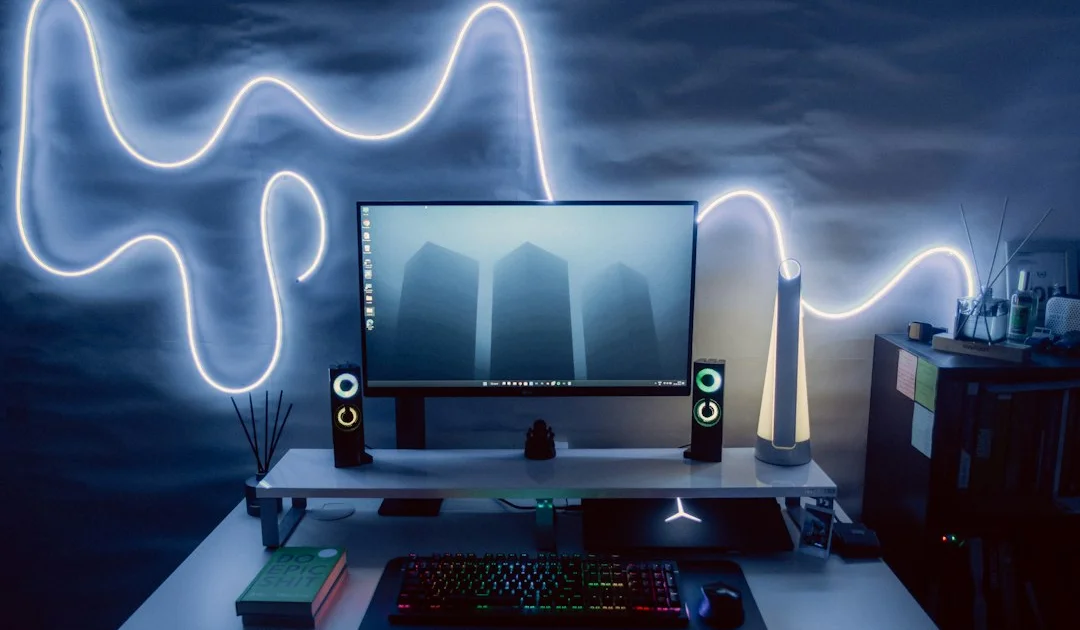
Imagine a world where your desktop isn't just a computer, but a personal AI supercomputer, capable of training complex models and deploying sophisticated AI right at your fingertips. This isn't a futuristic dream; it's the reality of November 2026. By the end of this year, Gartner forecasts that an astonishing 143 million AI PCs will ship, representing over half of all PCs worldwide, up from just 31% in 2025. This rapid transformation signals a profound shift: the 'Local AI Revolution' is here, moving AI processing from distant clouds directly to your desk.
This isn't just about faster chips. It's about a fundamental redefinition of what a computer can do, driven by specialized hardware, AI-native operating systems, and an urgent demand for data privacy, quicker development cycles, and predictable costs. For anyone building, creating, or innovating, the implications are enormous.
The Local AI Revolution: Why On-Device Power Matters More Than Ever
The biggest story in AI workstations right now is the powerful movement towards on-premise AI. Experts emphasize that this shift is driven by a growing need for local AI processing, especially for generative AI and deep learning. It offers greater control over your data, faster iteration speeds, and a more predictable total cost of ownership compared to endless cloud subscriptions (Source: buildez.ai).
Stanford's James Landay highlights 'AI sovereignty', explaining how countries and companies are building and running their own models on their own hardware. This ensures they maintain full control over their sensitive data and intellectual property (Source: buildez.ai). This isn't just a convenience; it's a strategic imperative.
The market is responding with incredible growth. The global AI workstation market is projected to reach an impressive $21.6 billion in 2026, a significant jump from $18.6 billion in 2025. It's expected to soar to $72.4 billion by 2034 (Source: fortunebusinessinsights.com). Workstations currently make up about 28% of the broader AI PCs market, which itself is valued at $131.81 billion in 2026 (Source: fortunebusinessinsights.com).
Hardware Wars: AMD, NVIDIA, and Intel Battle for AI Supremacy
The heart of the local AI revolution beats with incredible new hardware. Major players like AMD, NVIDIA, and Intel are locked in an intense battle, pushing the boundaries of what's possible on a desktop.
AMD's Aggressive AI Push
AMD has been particularly aggressive. In March 2026, they expanded their Ryzen AI portfolio with the **Ryzen AI 400 Series** for desktops and mobile workstations. These processors, along with the **Ryzen AI PRO 400 Series** for commercial applications, feature NPUs capable of up to 60 TOPS of AI compute. This power is designed to enhance productivity and enable robust on-device inference (Source: amd.com).
For the truly demanding, AMD unveiled the **Threadripper Halo Station** at IFA 2026 in September. This beast is touted as 'the most powerful workstation in the world', featuring a **Threadripper Pro 9995WX** with 96 Zen 5 cores. It also packs dual liquid-cooled **Instinct MI350P accelerators**, expandable to four, 2TB of DDR5, and 288GB of HBM3E, expandable to 576GB (Source: tomshardware.com, storagereview.com). AMD claims it can run trillion-parameter models, though its street price will likely exceed $100,000.
In October 2026, AMD also introduced the **Ryzen AI Halo Developer Platform**, powered by the **Ryzen AI Max+ PRO 495 processor**. This platform boasts up to 192GB of unified memory, supporting 300-billion-parameter and even larger models locally (Source: promptquorum.com).
NVIDIA's Blackwell and RTX Spark Dominance
NVIDIA, a long-time leader in GPU computing, continues to innovate with its **Blackwell Architecture**. The **RTX 5090** features a massive 32GB of GDDR7 VRAM, critical for intensive AI workloads (Source: buildez.ai).
At Computex 2026 in May, NVIDIA unveiled **RTX Spark**, a 'superchip' designed to transform thin Windows laptops and compact desktops into powerful AI ecosystems. RTX Spark links a 20-core **NVIDIA Grace CPU** to a **Blackwell RTX GPU** via NVLink-C2C, delivering up to 1 Petaflop of AI compute and 128GB of unified memory. Systems from major OEMs like ASUS, Dell, HP, Lenovo, and Microsoft Surface were expected in Fall 2026 (Source: nvidia.com, thetechrevolutionist.com). Just this month, in November 2026, NVIDIA announced the **Rubin HPC** GPU within its Vera Rubin platform, designed for high-performance computing with over 50,000 CUDA cores, further expanding its reach (Source: buildez.ai).
For more distributed AI work, NVIDIA also released the **DGX Spark HPC Developer Kit** in November 2026. This kit connects up to four DGX Spark systems, offering 512GB of combined memory and 16TB of NVMe storage, capable of distributing AI models with up to 700 billion parameters (Source: reviewramble.com). Their **DGX Station**, built on the GB300 chip, offers 748GB of memory and up to 20 petaflops of AI compute.
Intel's AI PC Push
Intel isn't sitting idly by. At CES 2026 in January, they unveiled their **Core Ultra Series 3 (Panther Lake)** processors, featuring a standalone NPU offering 50 Trillions of Operations Per Second (TOPS). These processors are already powering over 200 designs from partners like Dell, MSI, and Asus (Source: wifihifi.com, youtube.com).
In November 2026, a new AI workstation was unveiled, featuring dual **Intel Arc Pro B70 GPUs**. These cards, based on Intel's third-generation Battlemage architecture, offer a combined 64GB of GDDR6 ECC memory and 367 INT8 TOPS each, specifically designed for AI inference and professional workloads (Source: buildez.ai).
The Memory Crunch
All this hardware innovation comes with a cost. The memory and storage market is experiencing an 'AI-driven supercycle'. DRAM revenue is projected to surge 51% year-over-year and NAND 45% year-over-year in 2026. DDR5 prices jumped 80% to 110% through early 2026, and High-Bandwidth Memory (HBM) is in even higher demand, with AI data centers estimated to consume around 70% of high-end DRAM this year (Source: promptquorum.com, networkworld.com). This scarcity will likely continue to impact pricing for top-tier AI workstations.
The Brains Behind the Power: AI-Native Operating Systems and Agentic AI
The biggest shift in AI workstations isn't just the silicon, it's the operating system itself becoming AI-native. This is where the true intelligence of your machine comes alive.
Microsoft's 'Copilot OS' and Apple's 'NeuralCore OS', both launched in late 2025, feature always-on AI agents that learn user preferences and manage resources intelligently. Gartner reported in Q3 2026 that these AI-native operating systems increased developer productivity by an average of 35% due to automated code completion, debugging, and project management assistance (Source: buildez.ai, creativestrategies.com). This isn't just a minor improvement; it's a fundamental change in how we interact with our computers.
The rise of agentic AI is another major story for 2026. These systems perform complex, multi-step tasks autonomously. They plan, execute, monitor, and even self-correct, acting as true digital co-workers. OpenAI's agentic AI tool, Codex, saw its use jump from under 10% of the average worker's AI output in August 2025 to an astounding 99.8% by June 2026 (Source: buildez.ai, computerworld.com). Microsoft's chief product officer for AI experiences, Aparna Chennapragada, rightly calls 2026 a new era where AI agents become our 'digital co-workers' (Source: bloomberg.com).
This is where platforms like TashiOS shine. TashiOS is an AI-powered operating system that lets you describe your ideas in plain English to build real apps, websites, online stores, and Android apps. It simplifies the creation of sophisticated AI integrations and agentic workflows, making powerful AI development accessible to everyone, regardless of coding expertise.
VRAM is King: The Unsung Hero of On-Device AI Performance
While CPUs and NPUs grab headlines, for AI workloads, GPU memory, or VRAM, is paramount. It's the deciding factor for which models can be loaded and executed efficiently (Source: tensorrigs.com). A model simply cannot execute entirely on the GPU if it doesn't fit into available memory.
If model weights spill into system RAM, it leads to significant performance drops, often making the difference between real-time inference and painfully slow processing. This is why you see top-tier GPUs like the NVIDIA RTX 5090 with 32GB of GDDR7 VRAM, and platforms like AMD's Ryzen AI Halo Developer Platform offering up to 192GB of unified memory. More VRAM means bigger, more complex models can run locally, faster.
The Business Impact: Productivity, Privacy, and Predictable Costs
The shift to local AI workstations has profound practical implications for businesses and individual innovators.
First, it democratizes AI development. Powerful local AI workstations make advanced capabilities more accessible to individual developers, researchers, and small businesses. This fosters an explosion of innovation, as barriers to entry for complex AI projects are significantly lowered.
Second, companies are increasingly prioritizing on-premise AI workstations to reduce dependence on cloud-only AI for certain applications. This is driven by concerns over latency, data locality, connectivity constraints, and the often unpredictable long-term costs of continuous cloud subscriptions. Dell's analysis in September 2026 suggests that on-premises AI can lower average annual costs and shorten break-even timelines compared to public cloud solutions (Source: buildez.ai).
Third, enhanced productivity is a tangible benefit. As Gartner noted, AI-native operating systems and agentic AI are significantly boosting productivity, with a 35% average increase in developer output. Agentic AI systems are becoming 'digital co-workers', automating complex, multi-step tasks across various functions, freeing up human talent for higher-level creative work.
Finally, the no-code and low-code AI development movement has exploded. A Forrester report in Q2 2026 indicated that 60% of new business applications are now initiated on these platforms, a massive leap from just 15% in early 2024 (Source: buildez.ai). This empowers a broader range of users to create sophisticated, AI-powered solutions without needing extensive programming knowledge. TashiOS is built precisely for this future, allowing you to build and launch your online business with no code, driven by the power of AI.
What's Next for AI Workstations: Predictions for the Future
By the end of 2026, the concept of a 'non-AI' workstation might seem archaic. Every device, from smartphones to desktops, is expected to integrate powerful, locally run AI capabilities, making intelligent assistance and automation a default expectation. HP reported that AI-capable PCs accounted for nearly 60% of its PC shipments in Q4 FY 2026, exceeding its 50% target, showing this trend is well underway (Source: buildez.ai).
We'll see further advancements in multimodal AI, allowing seamless interaction across text, voice, image, and haptic feedback. This will create truly intuitive user experiences where your computer understands and responds to you in incredibly nuanced ways.
Many companies, including Lenovo and HP, are adopting 'Hybrid AI' strategies. This combines the best of both worlds: local workstations for development and inference, paired with cloud resources for scalable training or specialized services. This flexible approach offers both control and scalability, a powerful combination for the future.
The future of computing is undeniably local, intelligent, and deeply integrated into our daily workflows. The AI workstation isn't just evolving; it's redefining what's possible for creators and entrepreneurs everywhere.
Ready to build your own AI-powered future? TashiOS offers a powerful, no-code platform to turn your ideas into real apps, websites, online stores, and Android applications. Describe your vision in plain English, and let AI build it. Start free today with AI credits and join the local AI revolution.