
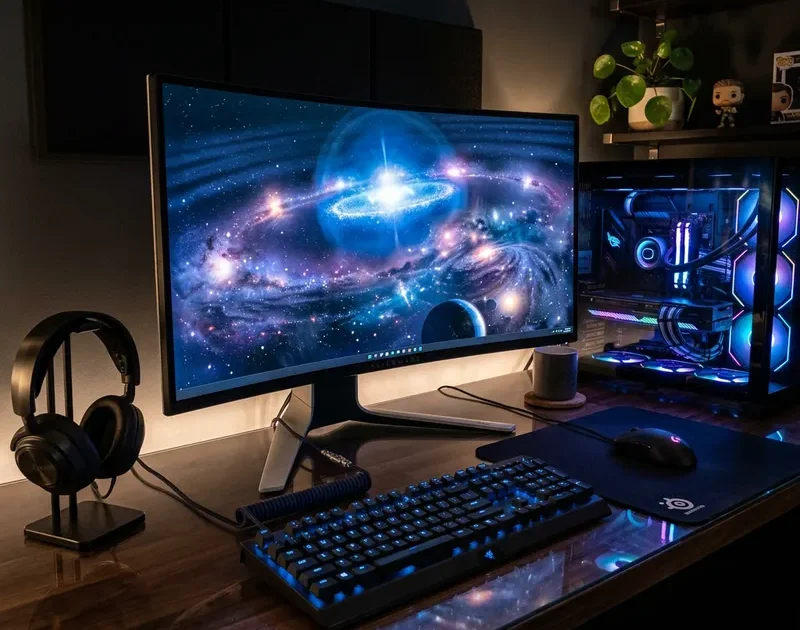
In 2025, a staggering 88% of organizations worldwide were already using AI in at least one function, a massive leap from just 55% two years prior. This isn't just a trend; it's a fundamental shift in how we work, create, and innovate. Fast forward to August 2026, and the heart of this revolution beats strongest within the AI workstation. These aren't your average high-performance machines. They're purpose-built powerhouses, transforming from mere tools into the nerve centers of a new, AI-driven economy.
The AI workstation market is experiencing rapid evolution, driven by a significant shift towards on-device AI processing and the proliferation of intelligent AI agents. Industry leaders like NVIDIA and AMD are at the forefront, introducing powerful new hardware and platforms designed to meet the escalating demands of AI development, inference, and generative AI applications. This comprehensive overview explores the latest developments, market dynamics, and the profound implications for creators and businesses alike.
The On-Device AI Explosion: From Cloud to Your Desk
The days of relying solely on distant cloud servers for intensive AI tasks are quickly fading. We're seeing an accelerating demand for on-device AI inference, a move fueled by the desire for lower latency, enhanced privacy, and reduced reliance on external cloud services. Data sovereignty rules also play a significant role, making local processing increasingly attractive for enterprises.
NVIDIA made waves at COMPUTEX 2026, unveiling their NVIDIA RTX Spark platform. This innovative solution targets thin Windows laptops and compact, high-efficiency desktop PCs, designed to run demanding AI workloads locally. It's a game-changer for developers, creators, prosumers, and business users, enabling local AI assistants, sophisticated content creation, software development, and complex 3D workflows right on their personal devices (NVIDIA.com).
Not to be outdone, AMD has also made significant strides. Their Ryzen AI Halo Developer Platform, announced in May 2026, can run models up to an astonishing 200 billion parameters with up to 128GB of unified system memory, supporting both Windows and Linux. This kind of local capability means less waiting, more iterating, and greater control over your AI projects (AMD.com).
This push towards local power has even spawned a new category: the Personal AI Supercomputer. Imagine data center-grade AI capabilities sitting right on your desk. Products like the NVIDIA DGX Spark Personal AI computer and the MSI Personal AI DGX Spark Supercomputer EdgeXper are democratizing enterprise-grade AI power, allowing individual creators and small studios to train complex neural networks and run large language models without needing constant cloud connectivity.
The Agentic AI Revolution: Your New Digital Teammates
AI is no longer just a passive tool; it's evolving into active "Agentic Systems" that plan, execute, and iterate on tasks autonomously. This represents a fundamental shift in interaction design, moving from conversational interfaces to delegative ones, where you give an AI agent a goal, and it figures out the steps.
Jakob Nielsen, a respected UX expert, boldly predicts that in 2026, AI will feel less like a software update and more like a structural reorganization of the workforce. He envisions AI agents proliferating and acting as "teammates" rather than mere tools (Substack.com). This vision is quickly becoming reality.
Gartner supports this outlook, forecasting that 40% of enterprise applications will leverage AI agents by the end of 2026, a significant jump from less than 5% in 2025 (Digital Applied). These agents are taking on diverse roles, from code development and data analysis to legal and financial operations. For platforms like TashiOS, this means users can describe their ideas in plain English, and AI agents, powered by these advanced workstations, can autonomously build real apps, websites, and online businesses, transforming abstract concepts into tangible products.
Hardware Heavyweights: NVIDIA and AMD's Power Plays
The intense competition between NVIDIA and AMD is a primary driver of the rapid advancements in AI workstation technology. Both companies are pushing the boundaries of what's possible on a desktop.
NVIDIA's Dominance: At COMPUTEX 2026, NVIDIA Founder and CEO Jensen Huang showcased a suite of new AI platforms. Beyond RTX Spark, they introduced the DGX Station for Windows, bringing powerful local AI development capabilities to enterprise desks. This allows organizations to build, run, and connect AI agents locally, reducing reliance on external data centers (NVIDIA.com).
For the ultra-high-end, the NVIDIA RTX PRO 6000 Blackwell Workstation Edition stands out. It's a premium choice for professional AI users, boasting an incredible 96GB of ECC VRAM, 4,000 AI TOPS, and 1,792GB/s memory bandwidth (Newegg.com, Corsair.com). And looking ahead, the "Vera Rubin" Platform, unveiled at CES 2026, promises next-generation H300 GPUs with advanced HBM4 memory later in 2026, targeting massive, trillion-parameter model training (NVIDIA.com).
AMD's Aggressive Stride: AMD's Advancing AI 2026 announcements in May and July painted a clear picture of their commitment to personal AI computing. The Ryzen AI Max PRO 400 Series processors integrate AI, graphics, and compute in a single architecture, specifically designed for professional workloads on next-generation Agent Computers and workstation-class systems (AMD.com).
Their MI350 Series, based on the new CDNA 4 architecture, promises a staggering 35x improvement in AI inference performance over its predecessor. AMD's upcoming "Helios" systems will also incorporate HBM4 memory, directly competing with NVIDIA's high-bandwidth offerings (ServeTheHome.com). Additionally, the Ryzen PRO 9000 Series processors deliver enhanced high-performance compute, and the Ryzen 9 9950X3D2 Dual Edition Processor, released in April 2026, offers dual AMD 3D V-Cache technology for developers, creators, and gamers (AMD.com).
Beyond the Benchmarks: What Makes an AI Workstation
An AI workstation isn't just a fast computer; it's a carefully balanced system optimized for AI workloads. The key components work in concert to prevent bottlenecks and maximize performance.
GPU Dominance is Undeniable: GPUs remain absolutely critical for heavy-duty AI model training and inference due to their parallel computation architecture. You'll want powerful GPUs with high CUDA core counts and substantial VRAM, typically 24GB or more for medium to large models. The NVIDIA RTX PRO 6000 Blackwell Workstation Edition, with its 96GB ECC VRAM, is a prime example of this necessity (Newegg.com, Corsair.com).
CPU Power for the Core: While GPUs handle the AI heavy lifting, a strong multi-core CPU is essential to prevent bottlenecks. It manages data preprocessing, post-processing, and runs multiple virtual machines or parallel tasks. AMD's Threadripper PRO series, with options like the Threadripper PRO 9000 WX-Series offering up to 96 cores and 192 threads, is a favorite among professionals for tasks like video rendering, 3D modeling, and complex simulations (AMD.com, AceComputers.com).
Memory and Storage: Ample system RAM, at least 128GB for professional tasks, ensures smooth operation when handling large datasets. High-speed NVMe SSD storage, 2TB or more, is also crucial for quickly loading and saving massive models and data. Beyond the traditional desktop, Qualcomm's Dragonwing Q-8750 processor is pushing the envelope for on-device AI, achieving 77 TOPS and supporting large language models with up to 11 billion parameters directly on the device, showcasing the versatility of AI hardware (TechnologyChecker.io).
The Market Roars: Growth, Adoption, and What's Next
The numbers don't lie. The AI PC market, which includes these advanced AI workstations, is experiencing phenomenal growth. The global AI PCs market was valued at USD 109.66 billion in 2025 and is projected to grow to USD 131.81 billion in 2026. Experts forecast it will reach USD 574.36 billion by 2034, exhibiting a Compound Annual Growth Rate (CAGR) of 20.20% (Mordor Intelligence). Another report is even more optimistic, predicting a CAGR of 42.8% between 2026 and 2036, reaching USD 3,645.4 billion by 2036 (Future Market Insights).
Workstations currently hold a significant share, approximately 28%, of this booming AI PCs market (Buildez.ai). This underscores their critical role in professional AI development and deployment. The overall artificial intelligence market itself is expanding at an incredible pace, valued at USD 390.9 billion in 2025 and projected to reach USD 539.5 billion in 2026, with an expected growth to USD 3,497.3 billion by 2033 (Grand View Research).
Geographically, North America continues to lead, holding the largest share of 35.5% of the global AI market in 2025 (Grand View Research). This regional dominance highlights the concentration of AI innovation and adoption in the area. The internal rollout of Copilot-ready notebooks to 200,000 Microsoft employees demonstrated that AI-native hardware significantly boosts measurable productivity, prompting Fortune 500 buyers to shorten refresh cycles (Techdogs.com).
TashiOS and the Future of Creation: Building with AI's New Power
The advent of powerful AI workstations and the rise of agentic AI fundamentally change the landscape for creators and entrepreneurs. For users of TashiOS an AI-powered operating system designed to build apps, websites, and online businesses with no code, these hardware advancements unlock unprecedented possibilities.
Imagine describing your dream app in plain English, and your TashiOS environment, powered by a next-gen AI workstation, can run larger, more complex local AI models and agents. This means faster iteration, enhanced data privacy, and a deeper integration of AI capabilities directly into your creative workflows. You're not just building; you're co-creating with intelligent systems that understand your intent and execute tasks autonomously.
With a robust AI workstation, TashiOS users can leverage on-device AI for real-time feedback during design, rapid prototyping, and even personalized AI agent training tailored to their specific business needs. This synergy between powerful local hardware and an intuitive, AI-driven no-code platform means that the barrier to entry for building sophisticated online presences and applications has never been lower. You can focus purely on your ideas, knowing the underlying AI infrastructure, whether local or cloud-assisted, is handling the heavy lifting.
Navigating the New Frontier: Challenges and Opportunities
While the future of AI workstations and agentic AI is incredibly promising, it's not without its complexities. It's crucial to acknowledge the potential pitfalls and prepare for them.
The Productivity Paradox: While AI is expected to deliver significant productivity gains, experts like Steven Rogelberg from UNC Charlotte predict that organizations will primarily use this saved time to take on more work, potentially hindering AI's promise to elevate humanity. Aruna Ranganathan from UC Berkeley anticipates "voluntary work intensification" as AI makes tasks feel easier, pulling people into more adjacent responsibilities. This will force organizations to rethink productivity metrics, shifting from counting output to evaluating real outcomes (Inc.com).
Uneven Adoption and Trust: Despite widespread availability, AI adoption within organizations will remain uneven in 2026. The primary barriers are not access to tools but issues of trust, accountability, and operating models. Skepticism will persist unless organizations focus on measurable outcomes, clear accountability, integrated workflows, visible guardrails, and managers who can coach effective AI use (Workera.ai).
Cost and Value: Gartner, while bullish on AI agents, also warns that over 40% of agentic AI projects will be canceled by 2027 due to escalating costs and unclear business value (Digital Applied). This highlights the need for a clear strategy and tangible ROI when implementing AI agent solutions, even with powerful local hardware.
Cybersecurity Imperatives: As AI becomes deeply embedded in critical systems and operates autonomously, cybersecurity will be more vital than ever. AI will monitor networks in real-time for anomalies, and multi-agent systems will collaborate to prevent threats, creating a new layer of digital defense that is both powerful and complex.
The AI workstation market in August 2026 is a vibrant, rapidly evolving ecosystem. From the raw power of NVIDIA's Blackwell and AMD's CDNA 4 architectures to the transformative potential of on-device AI and agentic systems, we are witnessing a fundamental reshaping of computing. For creators and entrepreneurs, this means unprecedented opportunities to build, innovate, and scale. Platforms like TashiOS are designed to make this power accessible, allowing you to turn your ideas into reality with the assistance of cutting-edge AI. Ready to explore what you can create? Start free with AI credits on TashiOS and experience the future of building today.