The AI workstation market is booming, projected to hit an impressive $21.6 billion in 2026, a significant leap from $18.6 billion just last year [4]. This isn't just growth; it's a revolution. Sophisticated AI model training and deployment are moving from distant cloud data centers right onto our desktops, driven by an insatiable demand for local AI processing power, especially for generative AI and deep learning [1].
For too long, the idea of serious AI work meant relying on the cloud. But that notion is quickly becoming outdated. Companies are increasingly prioritizing data privacy, regulatory compliance, and the often-unpredictable long-term costs of cloud compute. This shift is fueling a powerful movement towards on-premise AI workstations, putting control and speed directly into the hands of innovators [1].
The Local AI Revolution: Cloud's Reign is Over
The days of AI being exclusively a cloud phenomenon are behind us. The allure of local AI processing is undeniable, offering greater control, faster iteration speeds with local data, and a far more predictable total cost of ownership compared to continuous cloud subscriptions [1]. This isn't just about convenience; it's about strategic advantage.
Stanford's James Landay points to a growing movement towards "AI sovereignty." This concept sees countries and companies aiming to build or run their own models on their own hardware, ensuring they maintain full control over their data and intellectual property [1]. It's a clear signal that the future of AI is becoming more distributed, more personal, and more secure.
Hardware Powerhouses: GPUs That Define 2026
The engine of this local AI revolution is, without a doubt, specialized hardware. October 2026 sees a stunning array of GPUs pushing the boundaries of what's possible on a desktop.
NVIDIA's Blackwell Architecture Leads the Charge
NVIDIA's Blackwell Architecture is front and center. The RTX 5090 with its 32 GB of GDDR7 VRAM, stands as the fastest single-GPU solution for local AI development. While its street price in August 2026 hovered between $4,400 to $4,830, significantly higher than its $1,999 MSRP, its performance for demanding tasks is unmatched [1, 8].
For the professional realm, the NVIDIA RTX PRO 6000 Blackwell Workstation Edition boasts an incredible 96 GB of GDDR7 ECC memory and up to 4,000 TOPS of AI performance [1, 25]. This card offers the VRAM capacity needed for truly massive models.
NVIDIA also introduced the GB300 "Blackwell Ultra" Desktop Superchip. This powers high-end deskside systems like the NVIDIA DGX Station for Windows announced October 7, 2026. It features 252 GB of HBM3e and 496 GB of LPDDR5X system memory, totaling 748 GB of coherent memory, delivering up to 20 PFLOPs of FP4 performance. This system can run models approaching one trillion parameters locally [1, 9, 11].
For more compact, yet powerful, solutions, the NVIDIA RTX Spark platform is making waves. Launching in October 2026 in new Windows laptops and compact desktops from major OEMs like Dell, HP, ASUS, and Microsoft Surface, it offers up to 128 GB of unified LPDDR5X memory and one petaflop of FP4 AI performance. This means it can run models up to approximately 120 billion parameters locally, bringing serious AI power to mobile workstations [1, 13, 27].
AMD and Intel's Strong Contenders
AMD isn't standing still. Its Instinct MI300 series accelerators, based on the CDNA 3 architecture, offer up to 192GB of HBM3 memory (MI300X) [1, 19]. The AMD Instinct MI350P accelerators, with 144GB of HBM3E each, are set to power the upcoming AMD Threadripper Halo Station announced at IFA 2026 [1, 16]. This system promises a 96-core Threadripper PRO CPU and up to 2TB of DDR5 system memory, making it a direct competitor to NVIDIA's high-end offerings [1]. AMD's Radeon AI Pro R9700 also offers 32 GB of VRAM, providing a strong value proposition for users comfortable with ROCm on Linux [1].
Intel continues its evolution in the AI space. While its Gaudi accelerator roadmap has seen shifts, Intel Gaudi 3 remains active in PCIe and rack-scale deployments, boasting 128 GB HBM memory and 3.7 TB/s bandwidth [1, 21]. Intel's Core Ultra Series 3 processors, with integrated NPUs, are also found in mobile AI workstations, and the Intel Arc Pro B70 provides 32 GB of memory as an affordable workstation GPU option [1, 22].
Beyond the GPU: CPUs, Memory, and Unified Architectures
While GPUs grab headlines, the supporting cast of CPUs, memory, and storage is equally critical for a high-performance AI workstation. High-core-count CPUs remain essential for orchestrating complex AI workloads and managing data.
The AMD Ryzen 9 9950X with its 16 cores, is a favorite for single-GPU builds, offering a fantastic balance of speed and multi-threading capability. For multi-GPU systems, the AMD Threadripper 7980X with 64 cores and 128 PCIe 5.0 lanes, provides the necessary bandwidth and processing power to feed multiple accelerators [1]. NVIDIA's own Grace CPU, an ARM-based processor, is integrated into platforms like RTX Spark and GB300, showcasing the trend of tightly integrated CPU-GPU designs [1].
Memory, particularly VRAM capacity and bandwidth, is paramount. Experts emphasize it's often more critical than theoretical AI TOPS for real-world Large Language Model (LLM) inference performance [1]. A model simply cannot execute entirely on the GPU if it doesn't fit into available memory, leading to dramatic performance drops if weights spill into system RAM [1].
The "AI datacenter DRAM squeeze" has significantly impacted pricing, with DDR5 prices jumping 80 to 110 percent through early 2026 [1]. High-Bandwidth Memory (HBM) is in even higher demand, with analysts estimating AI data centers could consume ~70% of high-end DRAM in 2026 [1]. Fast PCIe 5.0 NVMe SSDs are now standard, ensuring rapid dataset loading and model checkpointing [1].
A defining trend is the rise of unified memory architectures. Here, the CPU and GPU share a single, large, high-bandwidth memory pool, removing data bottlenecks and allowing for much larger models to run entirely locally. This is a crucial innovation for the next generation of AI applications [1].
Agentic AI and No-Code: The New Frontier
October 2026 isn't just about raw power; it's about how that power translates into intelligent action. Microsoft's Aparna Chennapragada believes this year marks the point where AI transitions from a mere instrument to a true partner, thanks to the rise of "agentic AI." This advanced form of AI can reason, plan, and execute complex tasks with minimal human input [1].
Dell, NVIDIA, and Microsoft are actively collaborating to bring agentic AI capabilities directly to Windows PCs and workstations [1, 29]. This means we're seeing the emergence of private coding agents, the ability to prototype offline multi-agent systems, and real-time creative work, such as 12K video rendering or 4K AI video generation, all without exposing sensitive data to the cloud [1].
The release of OpenAI's GPT-5.4 and Google's Gemini 3 Pro in March 2026, both featuring 1-million-token context windows and autonomous multi-step workflow execution, further empowers this agentic future [1]. These models, when run on powerful local workstations, enable new levels of automation and creativity.
This is where platforms like TashiOS shine. With the power of local AI workstations, developers and entrepreneurs can describe their app or website ideas in plain English. TashiOS can then leverage these advanced local capabilities to build and deploy complex, agentic AI-powered applications with no code, ensuring data privacy and rapid iteration. Imagine creating sophisticated AI-driven applications and deploying them directly from your local AI workstation, all within a no-code environment.
Market Momentum: Billions Poured into AI Desktops
The financial figures underscore the magnitude of this shift. The global AI workstation market is projected to reach $21.6 billion in 2026, on its way to an incredible $72.4 billion by 2034 [1, 4]. This isn't just a niche market; it's a rapidly expanding segment of the broader AI PC market.
The broader AI PCs market size was valued at USD 109.66 billion in 2025 and is projected to grow to USD 131.81 billion in 2026, reaching USD 574.36 billion by 2034 with a CAGR of 20.20% [1, 5]. Workstations hold a significant share, approximately 28% of the AI PCs market, and are widely used across diverse industries like media and entertainment, engineering, healthcare, and scientific research [1].
Hardware made up the lion's share of the AI workstation market at 62.4% in 2025, with desktops being the most popular form factor [1]. Geographically, North America dominated the AI PCs market with a revenue share of 36% in 2025 [1]. Gartner forecasts that 143 million AI PCs will ship in 2026, representing over half of all PCs shipped worldwide, up from 31% (77.8 million units) in 2025 [1]. This points to a massive consumer and professional adoption curve.
The memory and storage market is experiencing an "AI-driven supercycle," with DRAM revenue projected to surge 51% year-over-year and NAND 45% year-over-year in 2026 [1]. This demand reflects the fundamental need for vast, fast memory and storage to power modern AI workloads.
What's Next: Predictions for the AI Workstation
The trajectory for AI workstations is clear: more power, more integration, and greater accessibility. We expect GPUs with even larger VRAM capacity and improved tensor processing units to continue emerging. Faster PCIe and memory technologies will also become standard, further enhancing data flow and overall system responsiveness [1].
The AI tech stack is evolving rapidly, demanding seamless integration of hardware and software. Intelligent UIs, orchestration APIs, multiple AI models, advanced memory systems, agents, and observability tools are all becoming part of the core offering. Frameworks like PyTorch and TensorFlow will remain essential, relying heavily on this advanced GPU acceleration [1].
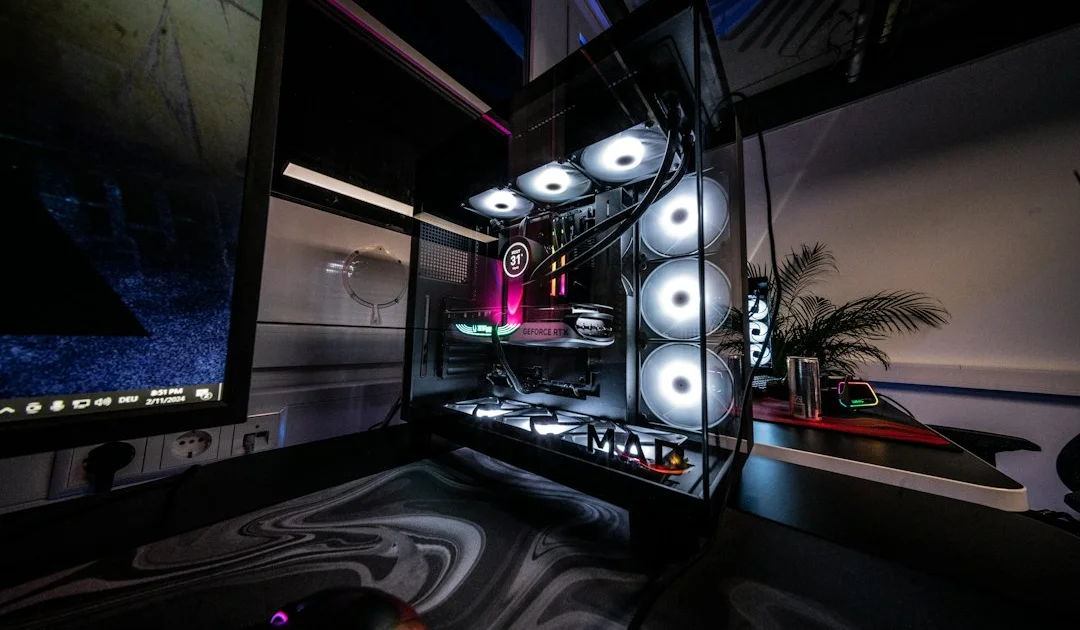
Liquid cooling is becoming increasingly common for high-power CPUs and GPUs in workstations, reflecting the need to manage the intense thermal output of these cutting-edge components [1]. This ensures sustained performance for long, demanding AI training sessions.
The democratization of AI, driven by these powerful local workstations, will only accelerate. Data scientists, researchers, and developers can run LLMs and complex AI workloads locally, reducing reliance on expensive cloud services and addressing critical data privacy concerns [1]. This shift also means AI skills are growing 8x faster than the overall jobs market, with a 62% average wage premium for workers possessing these skills. AI is even pushing traditionally senior-level skills into entry-level jobs, creating new opportunities [1].
The AI workstation in October 2026 is far more than just a powerful computer; it's a gateway to new possibilities. For those looking to build the next generation of online businesses, apps, and websites, the ability to iterate quickly and privately with sophisticated AI is an unparalleled advantage.
Ready to build the future from your desk? TashiOS empowers you to describe your ideas in plain English and build real apps, websites, and online stores with no code. Start free with AI credits and experience the power of AI-driven development firsthand.