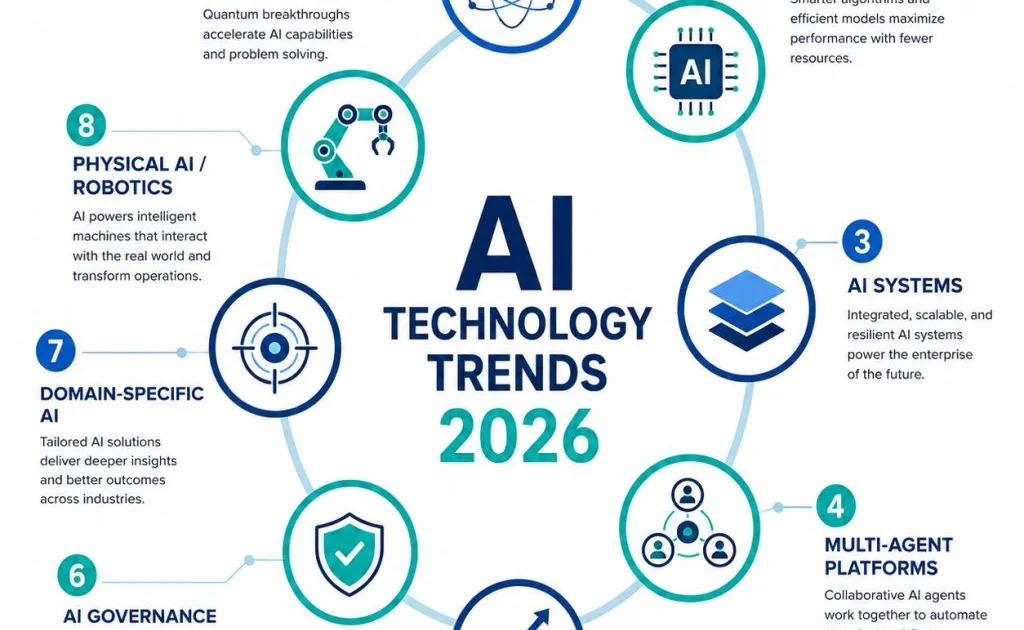
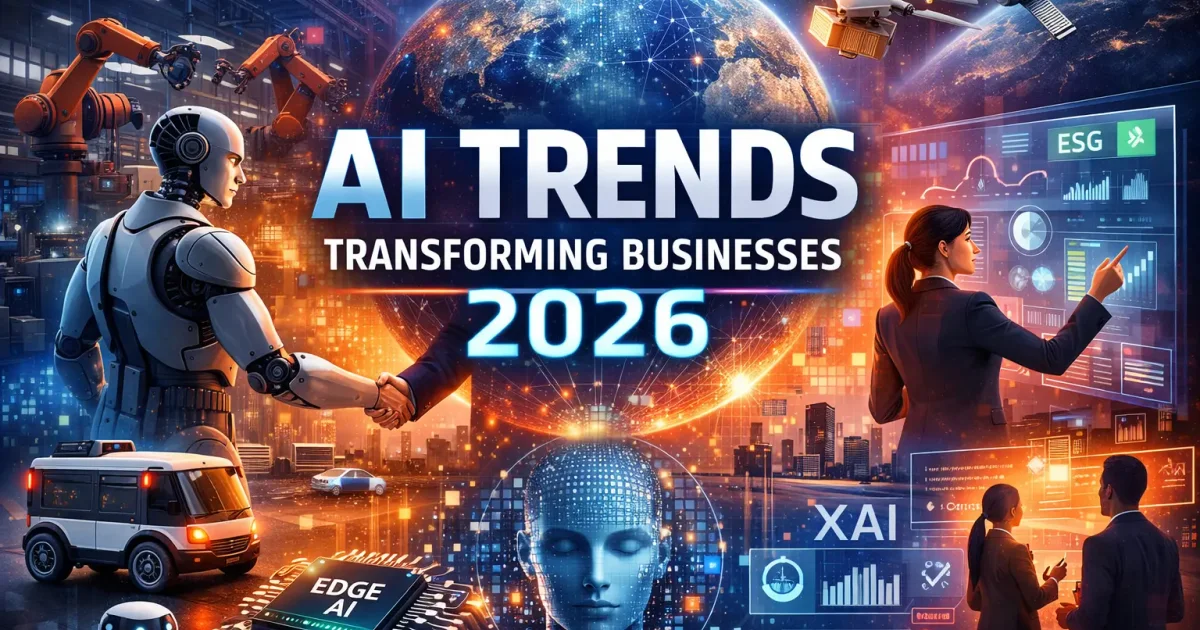
Imagine a world where AI doesn't just assist, but autonomously plans and executes complex tasks across your business. This isn't a distant future; it's the reality of June 2026, a pivotal moment where Artificial Intelligence has profoundly shifted from experimental projects to widespread, production-scale deployments.
Consider this astonishing fact: approximately $2.9 trillion in global data center construction is projected through 2028, and over 80% of that build-out is still ahead. This massive infrastructure investment isn't just about big tech; it's powering an AI revolution that's expected to contribute around 25% of U.S. GDP growth in 2026, according to Morgan Stanley. This isn't just growth; it's a structural transformation of our economy.
For businesses of all sizes, understanding this shift is no longer optional. It's about recognizing how autonomous and integrated AI systems are reshaping industries, amplifying human capabilities, and demanding a new approach to operations. Let's explore the key developments defining the future of AI right now.
AI's Economic Tsunami: The $2.9 Trillion Infrastructure Boom
The sheer scale of investment in AI infrastructure is breathtaking. We're witnessing an unprecedented global build-out of data centers, projected to reach nearly $3 trillion by 2028. This isn't a slow burn; it's a rapid acceleration that underscores AI's foundational role in economic expansion.
This infrastructure isn't just supporting existing AI, it's paving the way for exponentially more powerful systems. Analysts at Morgan Stanley predict this build-out will contribute a quarter of all U.S. GDP growth in 2026 alone. This makes AI not just a technological trend, but a primary driver of national economic health.
The challenge for businesses is to understand that AI is no longer a niche technology; it's the new backbone of global commerce. Companies that invest in AI readiness, from data infrastructure to workforce training, are positioning themselves for significant gains in this new economic era.
Autonomous Intelligence: Agentic AI Goes Mainstream
One of the most significant advancements in the future of AI is the maturation of agentic AI. These systems have moved well beyond pilot projects, now powering mission-critical workflows across diverse sectors. Agentic AI autonomously plans and executes multi-step tasks, coordinating across various tools, APIs, and data systems with minimal human oversight.
We're seeing this play out in real-world applications. Telecommunications leads the charge, with 48% of companies deploying agentic AI, closely followed by retail and CPG at 47%, as reported by Usetenfold.ai. These aren't just incremental improvements; they are fundamental shifts in how operations run.
Aparna Chennapragada, Microsoft's Chief Product Officer for AI Experiences, aptly describes AI agents as "digital coworkers" that empower individuals and small teams to achieve more (Microsoft.com). Microsoft itself unveiled "Scout" on June 5, 2026, an autonomous AI agent designed to operate across Microsoft 365 applications, further cementing this vision.
This shift means businesses can automate complex, multi-stage processes that previously required significant human intervention. For instance, platforms like BuildEZ.ai are making it easier for businesses to create complete, production-ready websites by automating design and development tasks, demonstrating how AI can streamline complex operations for everyone, not just large enterprises.
The New Generation of AI Models: Powering the Future
The foundational models driving this AI revolution continue to evolve at a rapid pace. June 2026 has seen a flurry of significant releases and updates, pushing the boundaries of what AI can achieve.
- OpenAI's GPT-5.4: Launched on March 5, 2026, this model features an impressive 1.05 million-token context window and a 33% reduction in factual errors compared to its predecessor, GPT-5.2 (AIweekly.co). This means more reliable and comprehensive AI interactions.
- Google's Gemini 3.1 Pro: Released in February 2026, it demonstrates strong performance, dominating 13 out of 16 major benchmarks (Blog.google). Google also integrated Gemini AI features across devices with the launch of Android 17 and Wear OS 7 in June 2026.
- Anthropic's Claude Opus 4.6: This model continues to excel in specialized tasks, achieving an impressive 80.8% on the SWE-bench for coding and demonstrating advanced complex reasoning capabilities (AIweekly.co). Anthropic further expanded its offerings in June 2026 with Claude Fable 5 and Claude Mythos 5, though their global access faced temporary U.S. government restrictions due to national security concerns, later restored with nationality-based controls (AIweekly.co).
- Microsoft's Proprietary Models: Beyond Scout, Microsoft unveiled MAI-Code-1-Flash for advanced code generation and MAI-Thinking-1 for sophisticated reasoning (Microsoft.com).
- Zhipu AI's GLM-5.2: Released under an MIT license on June 13, 2026, this model highlights the growing global contributions to open-source AI development (AIweekly.co).
These powerful models are the engines behind the autonomous systems we discussed, enabling them to understand, reason, and act with unprecedented sophistication.
From Novelty to Necessity: AI's Industry-Specific Impact
AI is no longer a futuristic concept; it's a present-day necessity for competitiveness across industries. Its impact is visible in tangible, transformative ways.
In the financial sectorAI is driving substantial returns by enhancing judgment-heavy tasks. KPMG's "AI in Finance 2026" report, published in May 2026, highlights how AI excels in planning, forecasting, and risk assessment (KPMG.com). Banks are now using knowledge agents powered by large language models (LLMs) to extract rich insights from loan applications and financial statements at scale. These advanced models are even improving access to credit by identifying creditworthy borrowers that traditional metrics might miss.
A significant partnership announced on June 17, 2026, further illustrates this. HSBC and Google Cloud are deploying AI capabilities across HSBC's global operations, aiming for over 200 new AI use cases within two years. High-value initiatives are expected to yield benefits exceeding US$100 million each, focusing on hyper-personalized wealth management and stronger financial crime risk management (HSBC.com).
In healthcareAI is moving from information gathering to reasoning and judgment. We're seeing increased adoption of virtual nursing, AI-assisted triage, and predictive tools that anticipate patient deterioration. A groundbreaking achievement came from the University of Cambridge, where researchers successfully completed initial human trials for an AI-designed vaccine, marking the first time a vaccine's key component was entirely developed by AI (Medium.com).
Manufacturing companies now consider AI essential for staying competitive. Generative AI is being used for product design and prototyping, allowing engineers to quickly generate and optimize multiple design variations virtually. Platforms like QAD Redzone, an agentic AI manufacturing platform, move from passive insight to autonomous action on the shop floor, adjusting production schedules and flagging quality deviations in real time (Conversight.ai).
Even in software developmentAI is a powerful coworker. Developers using GitHub Copilot complete coding tasks 55% faster (Medium.com). Vercel introduced Eve in June 2026, an AI cloud engineer designed to assist developers with deployment, debugging, and management of applications using natural language (AIweekly.co).
Unprecedented Growth: Market Data and Productivity Leaps
The numbers don't lie: the AI market is experiencing explosive growth. It's projected to reach $1,339 billion by 2030, a dramatic increase from an estimated $214 billion in 2024, with an annual growth rate of 36.6% from 2023 to 2030 (Motivalogic.com). Generative AI alone reached $91.57 billion in 2026, a 45% increase from 2025 (Crescendo.ai).
Total worldwide AI spending is expected to exceed $2 trillion in 2026 and climb to $3.3 trillion by 2029 (Motivalogic.com). This massive investment is a clear indicator of AI's perceived value and indispensable role in future business operations.
Enterprise adoption is robust, with 72% of businesses having adopted AI for at least one business function. A 2026 NVIDIA report indicates that 64% of organizations are actively using AI in their operations (NVIDIA.com). This adoption isn't just for show; it's yielding tangible benefits. A remarkable 88% of companies reported an increase in annual revenue due to AI, with 30% seeing a significant increase of over 10% (NVIDIA.com).
The impact on productivity is also evident. A 2025 report by the Federal Reserve Bank of St. Louis found that employees using generative AI tools saved approximately 2.2 hours per week, translating to a 5% productivity boost (ffb1.com). These aren't just isolated gains; they represent a fundamental shift in how work gets done.
Looking Ahead: The Multimodal, Autonomous, and Responsible Future of AI
The future of AI in 2026 points towards increasingly autonomous and integrated systems. Gartner predicts that by the end of 2026, 40% of business software will incorporate AI capable of completing end-to-end tasks independently, such as fraud detection or loan processing (Viewpointanalysis.com).
Multimodal AI is becoming the default, where systems seamlessly combine text, image, audio, and video inputs and outputs. This makes AI feel more like a collaborator than a mere tool (Bigdata.com). This shift will redefine roles, especially in content creation, where the skill will evolve from "making content" to "directing AI."
The widespread adoption of AI is also reshaping the workforce. While AI is projected to automate tasks accounting for 25% of all work hours in the US, data suggests that roles highly exposed to AI have seen 42% faster salary growth since 2021 (Sullivancotter.com). This indicates a shift towards amplifying human performance and creating new, higher-value roles, rather than simply replacing existing ones.
However, challenges remain. The energy consumption of data centers, a major driver of AI, is expected to reach 1,050 terawatt-hours by 2026, raising concerns about sustainability (Medium.com). Furthermore, the accelerating erosion of trust due to increasingly convincing AI-generated media, often called deepfakes, poses significant implications for journalism, democracies, and personal reputation (Berkeley.edu).
Experts like Barr Moses predict that "AI-ready data" will be the biggest topic of 2026, highlighting the critical need for clean, connected, and trustworthy data to power effective AI systems (Forbes.com). Governments are also taking notice. The New York City Department of Education, for example, issued preliminary guidance in June 2026, mandating that all AI tools undergo a bias and equity review before deployment (AIweekly.co). The White House issued an executive order on June 2, 2026, establishing a voluntary framework for AI model developers to provide access for cybersecurity and national security assessments (AIweekly.co).
On June 4, 2026, Representatives Jay Obernolte and Lori Trahan introduced the "Great American AI Act of 2026," proposing a national framework for frontier-model governance and requiring employers to disclose if AI was a substantial factor in mass layoffs (AIweekly.co). These developments underscore the growing importance of responsible AI development and deployment.
The future of AI in June 2026 is one of profound transformation. From the massive economic investment in infrastructure to the widespread adoption of agentic and multimodal systems, AI is no longer a futuristic concept but a present-day reality shaping every aspect of business and daily life. It's a world where AI amplifies human potential, streamlines complex tasks, and opens new avenues for growth and innovation.
As AI continues to evolve, making sophisticated technology accessible and easy to use becomes paramount for every business. Platforms like BuildEZ.ai empower you to harness the power of AI to create a professional online presence quickly and efficiently, letting you focus on what you do best. Explore how you can build and grow your business in this exciting new era of AI.