What if I told you that this year, 70% of all new applications built in major companies won't be made by traditional programmers? According to Gartner, that's not a future prediction. It's happening right now in March 2026.
The world of no-code tools has moved past being a simple trend. It's now a fundamental part of business strategy, an essential piece of infrastructure that's reshaping how we think about creating software. And at the center of this massive shift is one thing: artificial intelligence.
The No-Code Gold Rush: A $45 Billion Market That's Just Getting Started
Let's talk numbers, because they paint a stunning picture. The no-code development market is projected to hit an incredible $45.24 billion in 2026. That's not a typo. It's a massive market growing at a compound annual rate of 27.1%, with some estimates putting the combined low-code and no-code area well over $50 billion this year.
This isn't about small businesses making simple websites anymore. Fortune 500 companies are all in, with 38% adoption of no-code solutions as of early 2026. Why the sudden explosion? It's simple. Businesses are desperate for speed, and no-code delivers. Organizations report they can cut development costs by up to 70% and reduce development time by a staggering 90%.
The experts agree this is a permanent change. Gartner, a leading technology research firm, predicts the market will continue its meteoric rise, reaching over $102 billion by 2030. They're not just building faster; they're building differently, and a whole new class of creator is leading the charge.
AI Isn't Just a Feature, It's the Engine
Just a couple of years ago, AI in no-code was a neat trick. It could suggest a layout or write some marketing copy. In 2026, AI is the creative engine. The most advanced no-code platforms are now built around AI, not the other way around.
We've moved beyond simple generative AI into something far more powerful: Agentic AI. These aren't just tools that respond to prompts. They are autonomous agents that can manage entire workflows, connect different software, and execute complex tasks with minimal human input. They act as a layer between you and your software, translating your intent into action.
The market is already full of incredible examples:
- Google Opalpowered by the new Gemini 3 Flash, now lets non-technical users in Google Workspace build complex automated workflows with simple text prompts.
- Notion and Make.com both released new custom AI agent builders in late February, allowing users to create their own digital assistants for specific jobs.
- At Mobile World Congress in Barcelona this month, telecom giant KT launched its "Agent Builder," a no-code platform for creating AI agents by simply dragging and combining task templates.
This shift means the focus is moving away from the mechanics of building. You no longer have to worry as much about the 'how'. Instead, you can concentrate on the 'what' and 'why', defining the problem you want to solve and letting an AI co-creator handle the construction.
The New Builders: Who's Using No-Code Tools in 2026?
The rise of powerful no-code tools has given birth to the "citizen developer." These are people inside organizations, often in marketing, operations, or finance, who are now empowered to build the software they need without waiting in line for the IT department. According to Gartner, by this year, 80% of people using low-code or no-code tools will be from outside IT departments. Some analysts even predict that citizen developers will soon outnumber professional developers four to one.
So, what does this mean for professional developers? Are they out of a job? Absolutely not. Their role is evolving. Instead of writing every line of code for every internal tool, they're becoming architects and governors. They focus on the big, complex problems, build the core systems, and manage the security and performance of the applications created by their business colleagues. This hybrid approach, where professionals and citizen developers collaborate, is becoming the dominant strategy in large companies.
A 2025 Forrester study highlighted this perfectly, reporting that companies using these platforms saw a 30% reduction in their development backlog. They're not just building more; they're clearing the queue of projects that used to hold them back.
This collaboration frees up expensive developer time for high-impact work while empowering the rest of the company to innovate and solve their own problems faster than ever before.
A Look at the Top No-Code Tools Dominating the Market
The no-code market of 2026 is mature and diverse, with specialized tools for almost any need. While some long-standing leaders continue to thrive, a new generation of AI-native platforms is quickly gaining ground.
The Established Leaders
- Bubble: Still the king for building complex, full-stack web applications and MVPs without code. Its visual interface and integrated database serve over 2 million users.
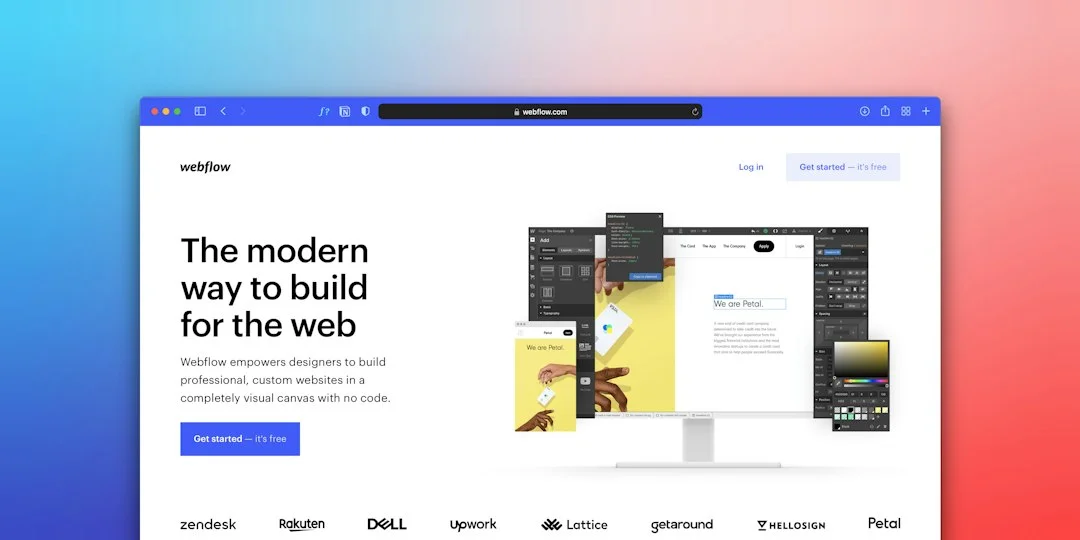
- Webflow: The top choice for designers who need pixel-perfect control for marketing sites and content-heavy platforms.
- Airtable: It has successfully positioned itself as a data-first AI platform, perfect for structuring information and building AI-driven workflows on top of it.
- Zapier & Make.com: These platforms are the essential glue of the internet, connecting thousands of apps to automate repetitive tasks and create powerful cross-platform workflows.
- Retool: When you need to build internal tools like dashboards or admin panels that connect to your existing databases, Retool is the go-to solution for developers.
The AI-Powered Newcomers
The most exciting developments are coming from platforms that were born in the age of AI. A February-March 2026 assessment identified Hostinger Horizons as a top no-code AI app builder for its ability to generate apps from natural language. This new wave of AI-first platforms, including recent standouts like Hostinger Horizons and our own BuildEZ.ai focuses on generating complete, production-ready applications directly from text prompts. You describe the site or app you need, and the AI builds it, backend and all.
The Contradiction: Is No-Code Making Us Build Less?
Here's a thought that might seem counterintuitive. As no-code tools become more powerful and intelligent, we might actually find ourselves building fewer traditional interfaces. The emphasis is shifting from the interface itself to the desired outcome. If an AI agent can book a meeting, generate a report, or update a customer record based on a simple command in a chat window, do you really need to build a dedicated interface with buttons and forms for that task?
This is where the concept of Generative UI (GenUI) comes in. Instead of static, hard-coded designs, interfaces of the future will be dynamic. They'll be generated in real-time based on the user's intent, context, and history. The app becomes less of a destination and more of a background service that surfaces the right controls at the right moment.
AI agents are becoming the default way to handle routine actions inside companies. They are replacing interfaces before they replace entire applications. This is a profound shift. It suggests a future where the best application is the one you barely have to see.
The Real-World Impact: Speed, Savings, and a Cleared Backlog
Beyond the futuristic concepts, the practical benefits of modern no-code tools are undeniable and are being felt today. The statistics on efficiency are almost hard to believe, but they are consistently reported across industries.
Teams using no-code are not just a little faster; they're 2.7 times faster than those using traditional development methods. This acceleration is what allows businesses to validate ideas, launch new products, and respond to market changes at a pace that was previously impossible. When you can build a prototype in a day instead of a month, you can afford to experiment, fail, and find the winning formula before your competition does.
The cost savings are just as dramatic. With zero-code AI platforms reducing development costs by 50-80%, companies can reallocate that budget to growth, marketing, and customer service. It's a fundamental change in business economics, driven by the democratization of software creation.
The evolution of no-code tools in 2026 is about more than just building websites or apps without a programmer. It's about changing the very nature of how we interact with software and who gets to create it. The fusion with powerful, agentic AI has turned these platforms from simple tools into true creative partners, allowing anyone with a great idea to bring it to life.
The era of describing what you want and letting an AI build it is here. Platforms like BuildEZ.ai are designed for this new reality, where your vision is the only blueprint you need. If you're ready to stop wrestling with complex builders and start creating at the speed of thought, the tools are finally here to make it possible.