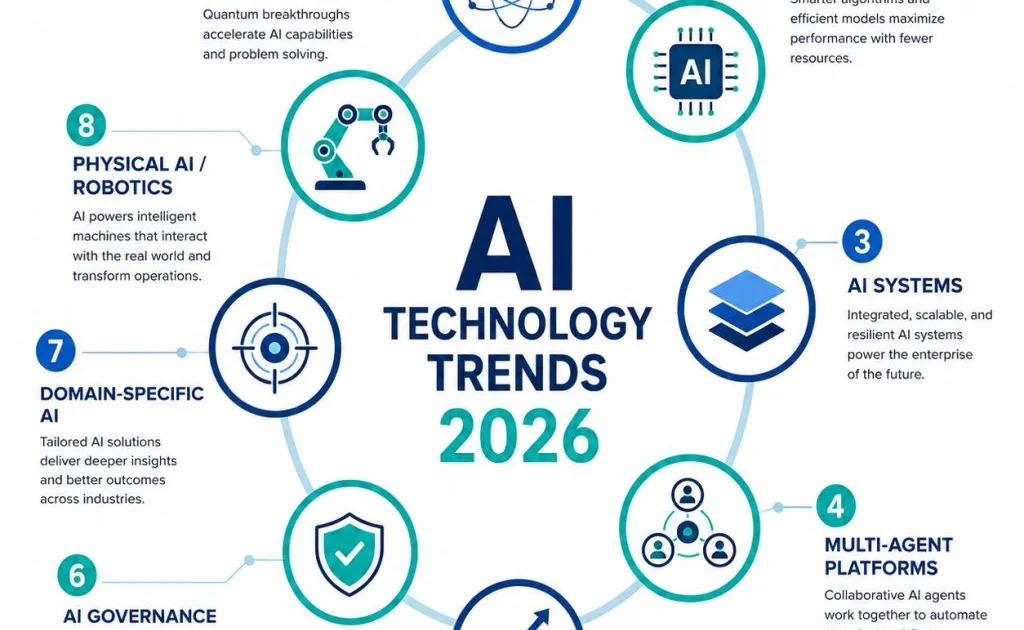
Did you know that by early 2026, approximately 30% of all new code on GitHub is AI-generated? That's a massive leap and a clear signal of where web development is heading. The digital world is always evolving, but the pace of change in 2025-2026 has been nothing short of revolutionary. We're seeing AI become a fundamental part of how we build, architectural patterns mature, and a renewed focus on security and efficiency. For anyone building online, understanding these shifts isn't just beneficial, it's essential.
AI at the Core of Web Development
Artificial Intelligence isn't just a buzzword anymore; it's deeply embedded in the web development lifecycle. In 2026, AI helps create hyper-personalized user experiences, dynamically adapting layouts and content based on individual behavior and real-time context. Imagine websites that anticipate your needs and offer proactive suggestions; that's the reality we're building.
Developers are now working extensively with AI APIs and machine learning models, focusing on data pipelines and ethical AI implementation. The data speaks for itself: 77% of developers worldwide use AI coding tools. GitHub Copilot, for instance, generates 46% of the code in files where it's enabled (Source: orbitallogics.com). Developers report 55% faster task completion and 75% less frustration when using these tools, which is a huge productivity boost (Source: orbitallogics.com).
However, this rapid adoption comes with a caveat. While AI generates code quickly, studies show it carries roughly 1.7 times more issues than human-written code. Code churn, meaning lines rewritten within two weeks, has also jumped 39% in AI-heavy projects (Source: orbitallogics.com). This isn't a reason to shy away from AI, but rather a call for vigilance. Experts emphasize that AI should be a co-pilot, augmenting developers, not replacing them. We must treat AI output as a draft, not a final deliverable, pairing AI's speed with human review and clear standards (Source: hamzafaiz.com).
Architectural Evolution: Micro-frontends, Serverless, and WebAssembly's Rise
The way we structure web applications is undergoing significant shifts, moving towards more modular, scalable, and efficient patterns. Micro-frontends are extending the benefits of microservices to the frontend, allowing independent teams to develop and deploy parts of the UI. This approach helps large organizations manage complex applications more effectively (Source: programming-helper.com).
Serverless architectures continue to grow, proving ideal for event-driven processing and API backends. They offer cost-efficiency and automatic scaling, letting developers focus on code rather than infrastructure (Source: vezadigital.com). This trend aligns perfectly with platforms like TashiOS which abstract away infrastructure complexities, letting you focus on building.
Meta-frameworks such as Next.js and Nuxt.js have become the standard starting point for many professional web projects. They handle crucial aspects like routing, data fetching, caching, and various rendering strategies, making complex web development more streamlined (Source: devnewsletter.com).
Perhaps the most transformative shift is the expansion of WebAssembly (Wasm). Wasm has seen significant adoption, with 41% of organizations using it in production by early 2026 (Source: logrocket.com). The release of WASI 1.0 in 2026 is standardizing system access for Wasm modules, turning it into a truly universal deployment target (Source: logrocket.com, programming-helper.com). Major cloud providers like Cloudflare Workers and AWS Lambda@Edge now support WebAssembly-based functions, offering microsecond cold start times (Source: logrocket.com). This capability is already powering critical infrastructure for companies like Figma and Adobe Photoshop Web, and American Express built its entire Function-as-a-Service platform on Wasm to achieve these impressive cold start times (Source: logrocket.com).
The Unseen Backbone: Security, Accessibility, and Sustainability
As the web grows, so do its vulnerabilities. Global cybersecurity spending reached $240 billion in 2026, a 12.5% year-over-year increase (Source: fortinet.com). Security literacy isn't just for specialists; it's now a core competency for all development teams. In cybersecurity web design, functional minimalism, dark mode as a default, and humanized infrastructure imagery are dominant trends, reflecting a focus on clarity and trust (Source: designrush.com).
Accessibility is another fundamental principle, crucial for inclusive design. Yet, despite widespread recognition, 95.9% of home pages still fail basic accessibility checks (Source: hamzafaiz.com). This statistic is a stark reminder that while we've made strides in technology, there's still a significant gap in ensuring the web is truly for everyone.
Beyond security and accessibility, sustainability is gaining traction. Developers are increasingly considering the environmental impact of their applications, focusing on efficient code, optimized infrastructure, and green hosting solutions. It's a quiet but growing movement towards a more responsible web.
No-Code and the Developer Workforce: A Shifting Landscape
The global web development market was valued at $61.2 billion in 2025 and is projected to reach $150.5 billion by 2035 (Source: mordorintelligence.com). This growth isn't just fueled by traditional coding; it's also empowered by the rise of no-code platforms. There are approximately 27.7 million software developers worldwide as of 2025, projected to reach 45 million by 2030 (Source: talent500.com). But the demand for digital solutions far outstrips the supply of traditional developers.
This is where no-code platforms truly shine. They're empowering a new generation of entrepreneurs and creators to build sophisticated applications without writing a single line of code. Platforms like TashiOS allow users to describe ideas in plain English and instantly build real apps, websites, online stores, and Android apps. This democratizes creation, making it possible for anyone to launch an online business, bypassing the steep learning curve of traditional programming.
While JavaScript remains the dominant language, with 65.6% usage among developers, and React holding a 40.6% framework market share, the no-code movement isn't a threat to these technologies; it's an expansion of the entire ecosystem (Source: programming-helper.com, sencha.com). It enables rapid prototyping, validates business ideas faster, and frees up traditional developers to tackle more complex, specialized challenges. No-code isn't just for beginners; it's becoming a strategic tool for rapid development and innovation across the board.
The Server-First Renaissance and TypeScript's Dominance
We're seeing a significant comeback for server-side rendering. Frameworks like Next.js and Astro are prioritizing server computation and minimal client-side JavaScript, leading to faster loading times and better performance. This "server-first renaissance" is about delivering content more efficiently and enhancing the user experience, directly impacting Core Web Vitals, which are now business-critical for engagement and search rankings (Source: medium.com).
TypeScript has solidified its position as the baseline for professional projects. Writing plain JavaScript for new projects is increasingly seen as a legacy approach. TypeScript provides end-to-end type safety, catching errors earlier and making large codebases more maintainable. If you're building a new web application today, TypeScript isn't an option; it's the standard (Source: devnewsletter.com).
Edge computing is also gaining momentum, moving applications and data processing closer to the user. This distributed infrastructure leads to faster content delivery, reduced latency, and a lighter load on central servers. It's an architectural decision driven by the need for speed and responsiveness in a globally connected world (Source: techtidesolutions.com).
Headless CMS: Powering the Modern Web
The rise of diverse frontend frameworks and the need for content flexibility have propelled headless CMS platforms into the spotlight. The headless CMS market is projected to grow significantly, with a compound annual growth rate (CAGR) of over 21% from 2026 to 2034, reaching $22.28 billion (Source: market.us). This market was valued at $1.19 billion in 2026 and is expected to reach $9.16 billion by 2036, with a CAGR of 22.6% (Source: futuremarketinsights.com).
Platforms like Sanity, Storyblok, Strapi, Contentful, and Kontent.ai are leading the charge, offering flexible content management decoupled from the presentation layer (Source: sanity.io, reddit.com). This approach allows developers to use their preferred frontend frameworks while content editors manage content centrally. It's a powerful combination that supports omni-channel delivery and highly customized user experiences, something traditional monolithic CMS solutions struggle with.
The web development world in September 2026 is dynamic, challenging, and incredibly exciting. AI is redefining how we code, architectural patterns are optimizing performance, and new tools are democratizing creation. The key isn't to resist these changes, but to embrace them strategically.
Ready to build the future of the web? With TashiOS you can bring your ideas to life using AI, without writing any code. Start building your next app, website, or online store today and go live faster than ever. Get started free with AI credits and see what you can create.