
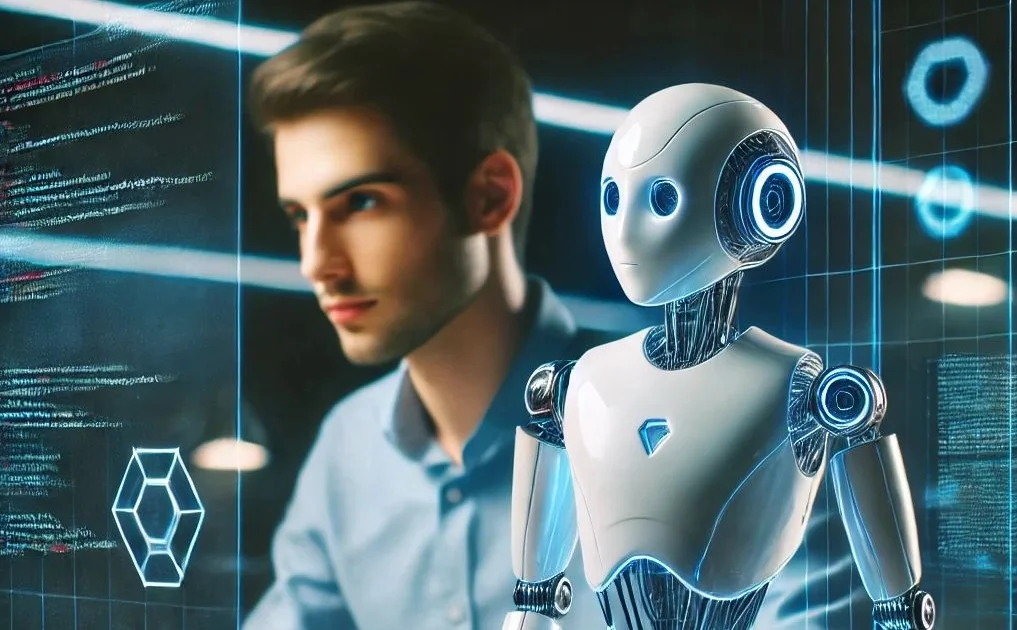
Imagine a world where nearly a third of all new code is written by artificial intelligence. That's not a prediction for some distant future, it's our reality in August 2026. Roughly 29% of new code is now AI-generated, marking a significant 45% year-over-year increase, according to industry reports. This isn't just a statistic; it's a fundamental reshaping of how we build and deliver digital experiences.
The web development area is in constant motion, but the last two years have seen an acceleration unlike any before. AI has moved from experimental feature to a core component, performance is a non-negotiable, and meta-frameworks have cemented their dominance. Let's break down the latest developments and what they mean for you.
The AI Revolution in Web Development: More Than Just Code
AI's influence on web development is pervasive. By 2026, it's woven into nearly every stage of building a site. This includes writing code, generating layouts, running tests, personalizing visitor experiences, and flagging bugs. It's an AI-first approach that's fundamentally changing workflows.
Developer adoption of AI coding tools is near-universal, with Stack Overflow's 2025 survey indicating 84% of developers use or plan to use AI tools. JetBrains' January 2026 survey found an even higher 90% of developers regularly use at least one AI tool at work. GitHub Copilot, for instance, is so widely adopted that 80% of new developers on GitHub use it within their first week, as per the GitHub Octoverse 2025 report.
Yet, this widespread adoption comes with a fascinating paradox. While developers are using AI tools extensively, trust in their accuracy is at a record low. Stack Overflow's latest survey reveals that only 3% of developers "highly trust" AI output. The primary frustration, cited by 66% of developers, is dealing with "AI solutions that are almost right, but not quite." This often means more time spent fixing AI output than saved writing it. There are also concerns about AI-generated code adding technical debt, with pull requests often carrying 1.7 times more issues and code churn increasing by about 39% in heavily AI-reliant projects.
This challenge highlights a crucial point: AI is augmenting developers, not replacing them. The role is shifting from typing syntax to prompt engineering and system architecture. Developers still need strong fundamentals in JavaScript, networking, performance, accessibility, and architecture. They must remain adaptable to learn new frameworks and tools quickly. The focus is on strategic thinking, user experience understanding, and business context, areas where human creativity and judgment remain irreplaceable.
Performance is Paramount: Speed Sells
In 2026, website performance isn't just a nice-to-have; it's a business-critical requirement. Core Web Vitals are increasingly tied to search rankings and user satisfaction, meaning slow sites face real penalties. Developers are laser-focused on lean codebases, optimized assets, and strategic loading patterns to ensure instant load times and responsiveness.
The metric "Interaction to Next Paint" (INP) has become crucial. It emphasizes how quickly a website responds to user input, capturing the true user experience of interactivity. Achieving excellent INP scores means meticulous attention to detail in asset delivery and client-side processing.
To meet these tightening speed expectations, more applications are moving to the edge. This means running code closer to the user, significantly reducing latency. Serverless computing, which cuts infrastructure costs and simplifies server management, is also expected to become the standard for web development by 2026. This combination ensures that performance is built in, not bolted on.
Meta-Frameworks and TypeScript: The New Standard
The way we structure projects has also evolved. Meta-frameworks like Next.js (from Vercel) and Nuxt have become the standard entry points for most professional web projects. They elegantly handle routing, data fetching, caching, rendering strategies, and API layers, streamlining development significantly. The stabilization of Server Actions and Functions has blurred the lines between frontend and backend, with the backend for many web applications now residing within the frontend repository.
Accompanying this shift is the undeniable dominance of TypeScript. It has solidified its position as the baseline for modern web development. Approximately 40% of developers now use TypeScript exclusively, while only about 6% still write plain JavaScript exclusively. This trend points to a preference for type safety, better tooling, and improved maintainability in complex projects.
Beyond frameworks, the underlying market data shows robust growth. The global web development market was valued at USD 61.2 billion in 2025. It's projected to grow at a Compound Annual Growth Rate (CAGR) of 9.4% during 2026, 2035, reaching approximately USD 150.5 billion by 2035 (market.us, truelysis.com). Front-End Development was the largest development type in 2025, holding 38.4% of the global market, with JavaScript Frameworks leading the technology segment with a 41.3% market share.
The Evolving Developer: From Typist to Architect
The role of a web developer is no longer about typing out every line of code. It's evolving into that of an "editor-in-chief." Developers focus on reviewing and directing AI-generated code, ensuring architectural soundness, seamless integration, optimal performance, robust security, and sharp product judgment. This shift means full-stack development is becoming the new normal, as the distinctions between frontend and backend continue to dissolve.
AI tools like ChatGPT (used by 82% of AI users) and GitHub Copilot (68%) are common aids, alongside Cursor and Claude Code. For design, Framer AI is making waves, while Surfer SEO uses AI for search engine optimization. Automated testing tools like Testim and Mabl, and security solutions like Cloudflare AI, are becoming indispensable. These tools automate routine tasks, freeing human developers for more strategic work.
This evolution also creates opportunities for platforms like TashiOS. By allowing users to describe ideas in plain English and build real apps, websites, and online stores with no code, TashiOS empowers a broader range of creators. It perfectly aligns with the trend of abstracting away the complexities of coding, letting individuals focus on their business vision rather than syntax.
“As of 2026, no credible research predicts large-scale replacement of web developers within the next five years. Instead, the developer role is shifting from typing syntax to prompt engineering and system architecture.”
This shift requires new skills. Developers need to be adept at prompt engineering, understanding how to guide AI effectively. They also need a deeper understanding of system architecture to integrate various AI components and services. The future of web development isn't less human, it's more human-centric, focusing on design, strategy, and problem-solving.
Security and Sustainability: Non-Negotiables for 2026
Beyond speed and AI, two other areas have become foundational: security and sustainability.
Uncompromising Security
Cybersecurity remains non-negotiable. The industry has seen a troubling increase in reported vulnerabilities and supply-chain attacks. For instance, npm supply-chain attacks increased by 150% from 2024 to 2026 (csoonline.com). A critical vulnerability, CVE-2026-66066, was disclosed on July 30, 2026, in the Ruby on Rails web application framework. Dubbed "KindaRails2Shell," it exploits the Active Storage component, potentially allowing unauthenticated attackers to read sensitive files or achieve remote code execution. This underscores the constant threat landscape.
Interestingly, AI tooling is making it significantly cheaper to implement security features correctly. However, it also introduces new challenges. Over 40% of AI-generated code carries a hidden vulnerability that needs human review. This highlights the double-edged sword of AI: powerful assistance, but requiring vigilant oversight.
A recent development from August 8, 2026, saw Oracle ban AI-generated code from OpenJDK contributions. They cited concerns around copyright, provenance, code quality, and contributor trust. This signals a growing need for explicit rules regarding AI-generated code in critical open-source infrastructure, a conversation that will undoubtedly continue to evolve.
Green Web Development
There is a rising trend towards sustainability and green web development. This focuses on optimizing websites for lower energy consumption, reflecting a broader societal push for environmental responsibility. From efficient code to optimized hosting, developers are increasingly considering the ecological footprint of their digital creations.
The Rise of No-Code and AI-Native Experiences
Low-code and no-code platforms continue to empower non-technical teams to build sophisticated digital experiences. The low-code and no-code market is on track to hit $187 billion by 2032 (classicinformatics.com). These platforms accelerate the creation of internal tools, prototypes, and Minimum Viable Products (MVPs). While they don't replace custom development for highly complex projects, they significantly support developers by automating routine tasks and democratizing access to creation.
Looking ahead to 2027, we'll see the emergence of truly AI-native experiences. Websites will act less like static content containers and more like online agents. They will interact, assist, and guide users through natural conversation, using built-in Large Language Models (LLMs). This means designing products around what AI models can do, rather than simply retrofitting chatbots onto existing codebases. It's a paradigm shift in user interaction and product design.
Headless CMS platforms and API-driven development are going mainstream, separating the frontend from the backend. This delivers content seamlessly across various devices and platforms. This composable architecture enables greater flexibility and scalability for omnichannel digital marketing, supporting the complex needs of AI-driven, personalized experiences.
What's Next for Web Development?
The web development area in August 2026 is dynamic, challenging, and full of opportunity. We're seeing a clear trajectory towards more intelligent, automated, and user-centric experiences. The developer's role is evolving, demanding a blend of technical skill, strategic thinking, and an editor's eye for AI-generated output.
The market continues its robust growth, with North America dominating in 2025, accounting for over 40.8% of the total market share. Asia-Pacific is projected to be the fastest-growing region, with a 17.05% CAGR, fueled by rapid digitization and a growing startup ecosystem (truelysis.com). This growth, combined with the power of AI, promises an exciting future for those building the internet.
Are you ready to build the future? With TashiOS you can bring your ideas to life with AI, creating apps, websites, and online businesses without needing to write a single line of code. Start your journey today with free AI credits and experience the next generation of web development firsthand.