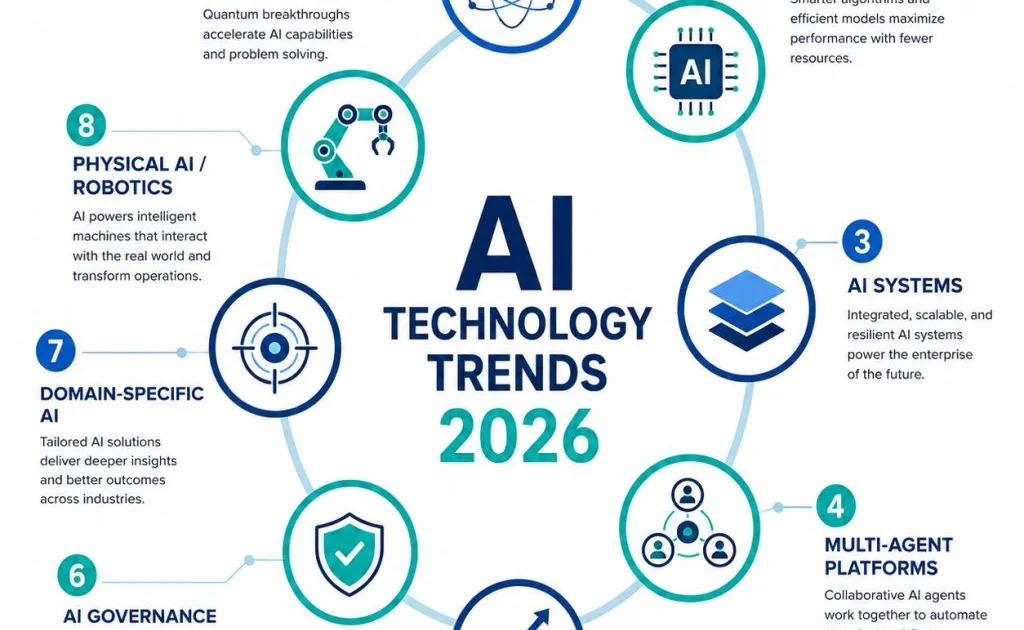

Imagine a world where AI doesn't just assist you, but actively works as your teammate, orchestrating complex tasks autonomously. That world isn't a distant dream; it's June 2026, and we're seeing this future unfold right now. ChatGPT, for instance, just blew past one billion monthly active users in the first week of June, a staggering testament to AI's global reach. This isn't just about chatbots anymore. We're watching AI move from interesting experiments to essential enterprise tools at a breathtaking pace.
nnThis month marks a pivotal moment. Agentic AI, where specialized bots collaborate on intricate workflows, is becoming the standard architecture across major industries. From finance to healthcare and software development, companies are deploying these systems at scale. The market is booming, regulations are tightening, and tech giants are making bold moves. Let's explore what AI trends this month are truly shaping our future.
nnThe Agent Leap: AI Becomes Your Autonomous Teammate
nThe biggest story this month is the \"agent leap,\" a fundamental shift in how AI operates. AI is no longer just a smart tool; it's evolving into an autonomous partner that can plan, execute, and adapt to complete complex tasks end-to-end. Multi-agent systems, which involve several specialized AI agents collaborating, are quickly replacing simpler single-model solutions in enterprise production environments.
nnTech giants are leading this charge. On June 5, 2026, Microsoft unveiled \"Scout,\" an autonomous AI agent designed to work across Microsoft 365 applications, performing tasks for users. Microsoft also introduced new proprietary AI models, MAI-Code-1-Flash for code generation and MAI-Thinking-1 for reasoning, emphasizing efficiency and lower costs (Source: microsoft.com). Not to be outdone, Google Cloud and IBM announced a multibillion-dollar partnership to help customers scale production-grade AI agents, combining Google's Gemini Enterprise Agent platform with IBM's Consulting Advantage.
nnThis shift means AI is becoming a collaborative partner, amplifying human expertise rather than simply replacing it, according to Aparna Chennapragada, Microsoft's chief product officer for AI experiences. Mark Dredze, director of the Johns Hopkins Data Science and AI Institute, predicts that 2026 will see a significant move towards specific, customized, and specialized AI applications (Source: jhu.edu). We're already seeing this in action with companies like Cohere, which launched North Mini Code, a 30-billion-parameter agentic coding model aimed at efficient software development.
nnBig Tech's June Blitz and Market Milestones
nJune 2026 has been a whirlwind for the biggest names in AI. Apple made a splash on June 8, 2026, introducing \"Siri AI,\" a completely new version of Siri powered by Apple Intelligence. This update brings a more conversational and capable assistant with personal context understanding, broad world knowledge, and on-screen awareness, deeply integrated across Apple's operating systems (Source: apple.com).
nnOpenAI also had a monumental month. On June 9, 2026, the company confidentially filed for an Initial Public Offering (IPO), signaling a major move to public markets. They also launched new usage analytics and spend controls for ChatGPT Enterprise and introduced a $150 million partner network to help build and deploy AI solutions. OpenAI is pushing its GPT-5.5 Instant model deeper into health use cases, showing improved performance on health-related evaluations.
nnHowever, the rapid pace isn't without its bumps. Anthropic launched its highly anticipated Claude Fable 5 and Claude Mythos 5 models on June 10, 2026. But by June 14-16, the U.S. government ordered Anthropic to suspend access to Claude Fable 5 due to security concerns and foreign user access. This incident highlights the increasing geopolitical and regulatory scrutiny on frontier AI models.
nnOverall, generative AI adoption continues to soar. As of February 2026, 57.9% of the U.S. population aged 18-64 uses generative AI, with 43.4% of employed individuals using it for work, saving an average of 2.2% of total work hours (Source: genaiadoptiontracker.com). Seventy-one percent of organizations regularly use generative AI in at least one business function, up from 65% in early 2024.
nnThe AI Economy: Growth, Investment, and Infrastructure
nThe numbers don't lie: the AI market is experiencing explosive growth. The global AI market was valued at USD 390.9 billion in 2025 and is projected to reach USD 539.5 billion in 2026 (Source: grandviewresearch.com). This represents a compound annual growth rate (CAGR) of 30.6% from 2026 to 2033, with estimates placing the market at USD 3,497.3 billion by 2033.
nnGenerative AI alone reached $91.57 billion in 2026, a 45% increase from 2025 (Source: explodingtopics.com). Gartner estimates total worldwide AI spending will exceed $2 trillion in 2026 and rise to $3.3 trillion by 2029, with a CAGR of approximately 22%. AI investments in 2025 hit $225.8 billion, with generative AI attracting $33.90 billion globally in private investment, an 18.7% increase from 2023.
nnThis growth is fueling massive infrastructure investment. Approximately $2.9 trillion in global data center construction is projected through 2028 to meet the accelerating demand for compute. NVIDIA remains a dominant force, controlling an estimated 81% of the AI data center chip market in 2026 (Source: ventionteams.com). This structural economic expansion is reshaping industries, with companies like American fintech Ramp believing AI is driving the biggest financial revolution since the spreadsheet.
nnData Quality: The Unsung Hero of AI Success
nWhile the spotlight often shines on new models and agents, experts are highlighting a less glamorous but crucial component: data. Barr Moses, an AI industry analyst, predicts that \"AI-ready data\" will be the biggest topic of 2026. Investments in data quality programs are expected to eclipse those in agent development, as AI's utility is directly tied to the quality of first-party data (Source: medium.com).
nnThis means organizations are prioritizing investments in data quality and governance to ensure their AI systems are powered by trustworthy and semantically rich information. For businesses looking to build a strong digital presence that can feed and benefit from AI, a platform like BuildEZ.ai becomes incredibly valuable. It helps you create a robust foundation for collecting and structuring your first-party data, ensuring your AI initiatives have the high-quality input they need to thrive.
nnReal-world examples show AI in action across sectors. In healthcare, French startup Zenkolab uses AI to analyze retinal images for early detection of eye diseases. An OpenAI-backed study showed reasoning models reanalyzed 376 previously unsolved pediatric rare-disease cases, leading to 18 new diagnoses. Google Cloud's 2026 AI Agent Trends report highlights AI agents reshaping manufacturing, from quality inspections to predictive maintenance. For these applications to work, the underlying data must be impeccable.
nnNavigating the AI Regulatory Maze and Ethical Concerns
nAs AI becomes more powerful and pervasive, so does the focus on governance and ethics. The regulatory environment is intensifying globally. On June 2, 2026, the White House issued an executive order, \"Promoting Advanced Artificial Intelligence Innovation and Security,\" establishing a voluntary framework for AI model developers to provide access for cybersecurity and national security assessments before public release.
nnCongress is also taking action. On June 4, 2026, Representatives Jay Obernolte and Lori Trahan released the \"Great American AI Act of 2026,\" proposing to nationalize the frontier-model governance approach emerging in several states (Source: hklaw.com). States like Colorado and California are enacting legislation focusing on automated decision-making, transparency, and content watermarking, with some laws taking effect as early as August 2, 2026.
nnThe EU AI Act's Code of Practice for marking AI-generated content is expected to be finalized by June 2026, with watermarking rules taking effect in November 2026. This complex web of regulations underscores that AI governance is an active obligation, not a passive consideration. The U.S. government's suspension of Anthropic's Claude Fable 5 model vividly illustrates the increasing scrutiny and geopolitical implications of advanced AI capabilities.
nnEthical considerations are also at the forefront. Hany Farid, a UC Berkeley expert, expresses concern over the accelerating erosion of trust due to increasingly convincing AI-generated media, predicting that deepfakes will become routine, scalable, and cheap in 2026 (Source: universityofcalifornia.edu). This raises critical discussions around algorithmic bias, dual-use technologies, and the integrity of information environments. Conferences like the Third Annual Rome Conference on AI, Ethics, and Governance (June 18-20, 2026) show the global effort to address these challenges (Source: foundationaieg.com).
nnWhat This Means for Your Business
nThe rapid evolution of AI in June 2026 presents both immense opportunities and significant challenges. AI is redefining workplace competence, requiring workers to demonstrate how they can use AI tools to enhance output while retaining critical human judgment. While AI will augment many roles, 32% of organizations anticipate workforce reductions due to AI by 2030.
nnFor businesses looking to stay competitive, embracing agentic AI and prioritizing AI-ready data are no longer optional. It's about building systems that are not only efficient but also compliant and trustworthy. This means investing in robust data governance, understanding the evolving regulatory landscape, and continuously adapting your strategies.
nnAs AI continues to reshape how we work and build, having a dynamic and adaptable digital presence is key. Platforms like BuildEZ.ai can help businesses quickly launch and update websites that serve as critical hubs for AI-driven operations, data collection, and customer interaction. The future of AI is here, and it's moving fast. Don't get left behind.
nnReady to build a website that's prepared for the AI-first future? Explore how BuildEZ.ai can help you create a modern, high-performance site quickly and efficiently, letting you focus on integrating the next wave of AI into your business.