
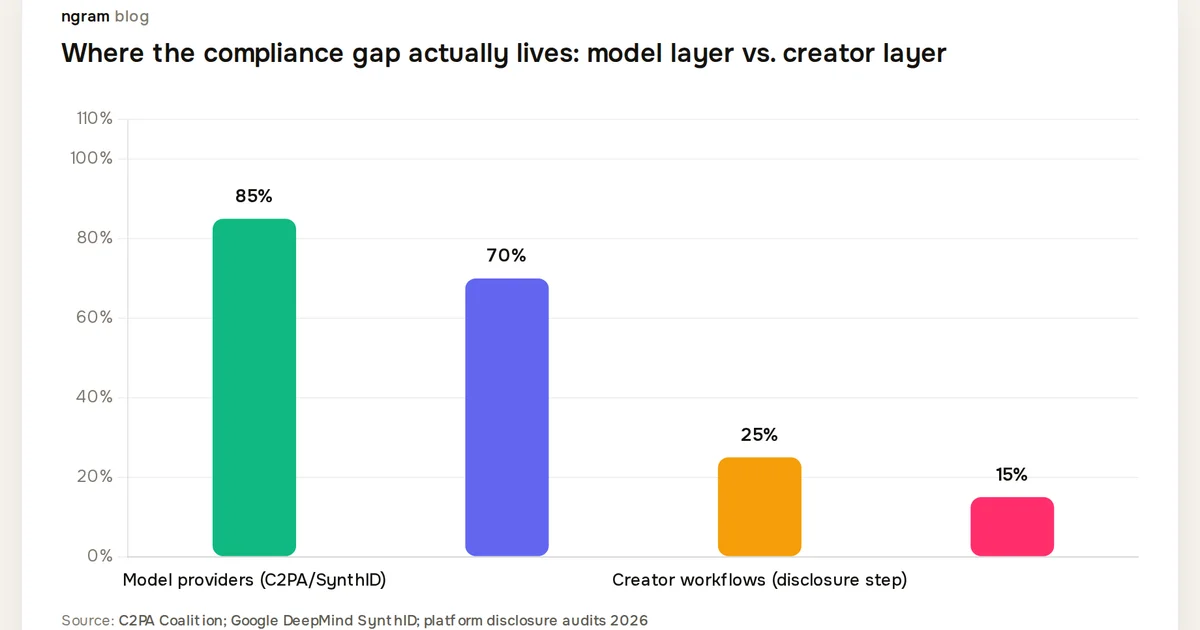
Imagine losing consumer trust overnight, or worse, facing hefty fines because your AI-powered ad didn't include a tiny disclosure. This isn't a hypothetical scenario for 2030, it's the reality for digital marketers in 2026. A Q2 2026 survey by Fractl revealed that the share of consumers who would distrust a favorite brand due to heavy AI use doubled from 20% in 2025 to a staggering 40% in 2026. This stark statistic underscores a critical shift: the digital marketing world is no longer just talking about AI adoption, it's grappling with mandated AI transparency and accountability.
nNew AI marketing laws are taking effect across different regions, creating a complex web of compliance. From New York's specific rules on synthetic performers to the EU AI Act's comprehensive transparency obligations and the FTC's intensified scrutiny, brands face immediate legal and ethical challenges. Navigating this rapidly evolving environment requires more than a passing awareness. It demands a proactive strategy focused on explicit disclosure to ensure compliance, maintain consumer trust, and avoid significant penalties.
nnThe New Regulatory Reality: What's Changing in 2026?
nThe year 2026 marks a pivotal moment for AI marketing regulation, with several key legislative frameworks now in force or seeing increased enforcement. Marketers must understand these diverse requirements to protect their brands.
nnNew York's Synthetic Performer Disclosure Law
nEffective June 9, 2026, New York's groundbreaking legislation, signed by Governor Kathy Hochul, mandates conspicuous disclosure in visual or audiovisual advertisements shown to New York audiences. This applies to ads featuring 'synthetic performers,' which are digitally created human-like assets not identifiable as real persons. Failure to comply carries civil penalties of $1,000 for a first violation and $5,000 for subsequent violations, as detailed by sources like ny.gov and honigman.com. It's a clear signal that the use of AI in creating human likeness in advertising is now under strict legal oversight.
nnEU AI Act's Transparency Obligations
nThe European Union's comprehensive AI Act, Regulation (EU) 2024/1689, sees its critical transparency obligations under Article 50 become effective on August 2, 2026. These rules are far-reaching. They require AI chatbots and virtual assistants to clearly inform users they are interacting with AI at the first interaction. Providers of generative AI tools, such as Google Gemini, ChatGPT, Canva, or Adobe Firefly, must mark their outputs as AI-generated using machine-readable formats like watermarks or metadata. Explicit disclosure is also needed for 'deepfakes,' and for AI-generated text published to inform the public on matters of public interest, unless a human has genuinely reviewed and taken editorial responsibility. The EU AI Act also requires disclosure when emotion recognition or biometric categorization systems are used in advertising contexts (europa.eu, crowell.com). Penalties for non-compliance with Article 50 can reach up to €15 million or 3% of global annual turnover, whichever is higher, as reported by artificialintelligenceact.eu.
nnFTC AI Policy and Enforcement
nThe Federal Trade Commission (FTC) has maintained its \"Operation AI Comply\" initiative, with sustained enforcement actions. The FTC now requires 'double disclosure' for AI-involved sponsored content, meaning both the paid relationship and the use of AI in content creation must be disclosed. Penalties for non-compliance can reach $53,088 per violation in 2026. In late 2025, the FTC brought its first enforcement action specifically targeting undisclosed AI-generated advertising content, involving an AI-generated fake review case. Early 2026 saw the FTC settle with Growth Cave for $48.6 million over unsubstantiated claims about its AI software automating 'nearly 100%' of online course building, when users were required to perform most tasks manually (dynamisllp.com, kelleydrye.com). This shows the FTC is serious about both transparency and accuracy in AI marketing claims.
nnFragmented US State Landscape
nWhile a White House Executive Order issued on December 11, 2025, seeks to establish a national AI policy framework, other US states like California, Colorado, and Utah have already enacted or are developing laws focusing on transparency for consumer-facing AI interactions, AI-driven decisions, and provenance requirements for AI system providers. This creates a patchwork of regulations that marketers operating nationally must navigate carefully (dglaw.com).
nnThe Trust Deficit: Why Consumers Demand Transparency
nThe surge in AI marketing adoption, projected to grow from $12.05 billion in 2020 to $107.54 billion by 2028, comes with a significant challenge: dwindling consumer trust. As of Q2 2026, 56% of marketers have integrated AI into data-driven work, yet consumers are increasingly wary.
nThe Fractl survey from Q2 2026, which showed a doubling of distrust in brands using heavy AI, is a wake-up call. Only 14% of consumers reported increased trust, and Gen Z showed the highest likelihood of reduced trust at 54%. Similarly, Klaviyo's 2026 AI Consumer Trends Report found that only 13% of consumers completely trust AI, with 30% remaining neutral. Gartner research from June 2026 indicated that 49% of US consumers believe generative AI has worsened content quality, and half would prefer to buy from brands that avoid AI in customer-facing content altogether (klaviyo.com, cxtoday.com).
nHowever, transparency can bridge this skepticism. Research in 2025 showed that 62% of consumers would trust brands more if they were transparent about their AI use. Klaviyo's 2025 AI Shopping Index found that 40% of consumers reported AI assistants improving brand trust, a figure that rose to 55% among millennials and 56% among Gen Z. This suggests that the problem isn't AI itself, but rather the lack of honesty about its deployment.
nnnnColin Hetherington, writing in AdWorld.ie in June 2026, suggests that while the EU AI Act's Article 50 presents new obligations, a small label disclosing AI use costs almost nothing. The absence of one, however, could be far more damaging if a 'real' testimonial is later revealed to be AI-generated.
n
Experts emphasize that transparency is crucial for bridging the gap between AI capabilities and consumer trust. Ethical AI marketing is increasingly seen as a competitive advantage, reducing reputational risk and strengthening customer relationships. Okoone (March 2026) argues that AI disclosure should be driven by ethics, focusing on context, consequence, and audience impact, rather than rigid bureaucracy. They caution that over-disclosure can weaken credibility and confuse audiences, while under-disclosure risks trust and legal repercussions (adworld.ie, okoone.com).
nReal-world examples confirm this. The backlash against Coca-Cola's 2023 AI-generated holiday advertisement, which viewers derided as 'soulless,' underscores the potential for consumer rejection of undisclosed or poorly executed AI content (youtube.com). Conversely, some brands are proactively addressing skepticism. Aerie and Le Creuset, for example, are running 'no AI' pledges as affirmative marketing positions, aiming to build trust by explicitly stating their content is AI-free (technologychecker.io).
nnBeyond Compliance: Making Transparency Your Competitive Edge
nWhile the immediate focus is on avoiding penalties, smart brands will see AI transparency as more than a regulatory burden. It's a strategic opportunity to build deeper customer relationships and differentiate in a crowded market. The speed of AI adoption is undeniable, with 53% of marketing work now passing through AI tools in Q2 2026, up from 38% in 2025. However, 48% of marketers reported that AI made their work faster but resulted in more average quality, highlighting the need for human oversight and ethical consideration.
nEthical AI marketing isn't just a buzzword; it's becoming a foundational element of brand integrity. By proactively communicating how AI is used, you can transform a potential liability into a trust-building asset. This means moving beyond generic statements to specific, meaningful disclosures that reassure consumers and demonstrate a commitment to responsible technology use. For example, a website built with BuildEZ.ai can easily incorporate transparent AI usage policies directly into its footer or a dedicated 'Our AI Promise' page, signaling your commitment from the moment a visitor lands on your site.
nThis proactive approach can reduce reputational risk significantly. In an era where a single misstep can go viral, preventing a trust crisis is far more effective than reacting to one. Brands that embrace transparency as a communication asset, rather than just a compliance cost, will be better positioned for long-term loyalty and sustained growth.
nnPractical Steps for AI Content Disclosure
nWith penalties looming and consumer trust at stake, marketers need clear, actionable strategies for AI content disclosure. The European Commission's voluntary Code of Practice on marking AI-generated content, published June 10, 2026, offers guidance for compliance with the EU AI Act's transparency obligations (europa.eu). While voluntary, non-signatories may face higher regulatory scrutiny, underscoring the importance of best practices.
nn- n
- Visible Labeling: Disclosures must be conspicuous and easily noticeable. Think 'Content generated with AI assistance' or 'AI-enhanced content' in campaign footers, product descriptions, or alongside images. This isn't about burying a disclaimer in fine print; it's about making it obvious. n
- Contextual Application: The prominence and method of disclosure should depend on the content's potential impact and the extent of AI involvement. More visible methods are needed when AI-generated content could influence significant decisions (for example, health, finance, or public communications) or affect consumer rights, safety, or trust. A simple AI-generated social media caption might need less prominent disclosure than a deepfake advertisement. n
- Explain the Role of AI: Beyond simply stating AI was used, marketers should clarify *how* AI was involved and emphasize human oversight to maintain authenticity. Did AI help generate initial ideas, or was it used for final image rendering? Explaining the human-AI collaboration fosters greater understanding and trust. n
- Consistency Across Channels: A single, clear standard for AI disclosure should be maintained across all platforms. This includes blogs, websites, newsletters, email campaigns, and social media. Inconsistent messaging can confuse consumers and erode trust. An AI website builder like BuildEZ.ai can help standardize these disclosures across all your web content, ensuring a unified approach. n
Establishing robust internal processes is crucial. This means formal documentation of decisions related to algorithmic model selection, training datasets, and output analysis. Reviewing and updating vendor and agency contracts is also vital to clearly allocate responsibility for identifying AI-generated elements and ensuring compliance. The focus will shift to an 'operator perspective,' defining who decides, builds, reviews, measures, and is liable for AI in marketing.
nnThe Future of AI Marketing: Personalization, Accountability, and AI-First Websites
nThe regulatory trajectory suggests an even more controlled environment for AI marketing in the coming years. While AI offers powerful personalization capabilities that can enhance brand trust, concerns about manipulative personalization and algorithmic bias are driving regulations. States are refining consumer rights to opt out of profiling and automated decisions, indicating a future with stricter controls over AI-driven personalization (mcdermottlaw.com).
nWe predict a significant shift towards 'privacy-by-design' and 'transparency-by-design' in AI marketing tools and platforms. The fragmented US state landscape, combined with the comprehensive EU AI Act, will push for a default of disclosure and user control. Brands that anticipate these changes and integrate ethical AI practices into their core operations will lead the market.
nWebsites, as the central hub of digital marketing, will play an increasingly critical role in demonstrating compliance and transparency. Future-proof platforms, such as BuildEZ.ai, will need to offer built-in features that simplify AI content disclosure, manage consent for AI-driven personalization, and provide clear pathways for users to understand how AI interacts with their data. This isn't just about adding a checkbox; it's about embedding ethical AI principles into the very architecture of your online presence.
nThe 'operator perspective' will become paramount. Marketing teams won't just be users of AI; they will be accountable stewards. This means defining clear internal policies that balance the speed of AI with accuracy and ethical considerations. The era of 'move fast and break things' with AI in marketing is over. The new imperative is 'move smart and build trust.'
nnFinal Thoughts: Your Path to Compliant AI Marketing
nThe digital marketing landscape in 2026 is defined by a clear mandate: transparency and accountability in AI-driven campaigns. From New York's specific disclosure laws for synthetic performers to the EU AI Act's broad requirements for generative AI and the FTC's watchful eye, the stakes have never been higher. Ignoring these AI marketing laws isn't an option, as the financial penalties and damage to consumer trust are too great.
nInstead, view this moment as an opportunity. By embracing AI transparency and focusing on digital marketing ethics, you can not only ensure marketing compliance for 2026 but also forge stronger, more trusting relationships with your audience. This proactive approach turns regulation into a competitive advantage, positioning your brand as a leader in responsible AI use.
nReady to build a website that's not just powerful but also compliant and transparent in the age of AI? Explore how BuildEZ.ai can help you create stunning, production-ready websites with built-in features to manage your AI content disclosures and future-proof your digital presence. Start building trust and compliance into your marketing from day one.