Did you know the global AI market is projected to hit nearly $1 trillion in 2026? (Grandviewresearch.com) That's a staggering figure, but it doesn't tell the whole story. As we look at what's truly shaping AI trending April 2026, it's clear we're witnessing more than just growth. We're in the midst of a fundamental architectural shift, moving from AI assistants to fully autonomous AI agents.
This isn't just about making tasks easier. It's about AI systems that can receive a goal, break it down, execute actions across various tools, and deliver outcomes, often without human hand-holding. This shift is redefining how we work, create, and build businesses. Let's explore the key developments.
The Agent Revolution: From Assistants to Autonomous Partners
The biggest story in AI right now is the rise of agentic AI. We're no longer just asking AI to generate text or images; we're giving it complex goals and letting it figure out the steps. Deloitte predicts that by 2025, 25% of companies using Generative AI (GenAI) will pilot autonomous agents, a figure expected to double to 50% by 2027. (Deloitte.com)
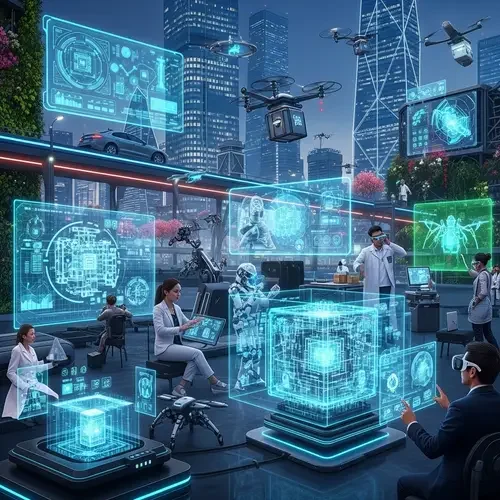
Gartner echoes this, projecting that enterprise applications integrated with task-specific agents will jump from less than 5% in 2025 to a significant 40% by the end of 2026. (Cranium.ai) This means AI is evolving from a helpful instrument to a true partner, capable of transforming fields like medicine, software development, and scientific research. Imagine an AI lab assistant, not just an analysis tool.
For businesses, this means unprecedented automation. Instead of just helping a customer service agent, an AI agent could resolve an entire customer issue end-to-end. This move towards autonomous workflows is the defining architectural shift in 2026, offering massive efficiency gains and opening new possibilities for innovation.
The Billion-Dollar Bet: Inference Takes Center Stage
While the headlines often focus on the latest, largest AI models, the real enterprise investment is shifting. The focus is no longer just on training these massive models, but on inference, which is the ongoing cost of running them in production at scale. Deloitte's 2026 TMT Predictions report indicates that inference will account for two-thirds of all AI compute in 2026, up significantly from one-third in 2023 and half in 2025. (Deloitte.com)
This massive demand for inference is fueling a specialized chip market, forecast to exceed $50 billion in 2026. (Deloitte.com) Companies like NVIDIA remain critical enablers, with their powerful GPUs and CUDA platform essential for both training and deploying complex AI models. (NVIDIA.com) Their stock price surged 171% in 2024 due to this demand, a clear indicator of the market's direction. (Forbes.com)
This shift means companies are prioritizing the practical, real-world application of AI. It’s about getting AI to work for businesses every day, not just building bigger, more impressive models in a lab. The costs of running AI are becoming a major consideration, driving innovation in efficient inference hardware and software.
Multimodal AI and the Democratization of Innovation
Another major trend for AI trending April 2026 is the surge in multimodal AI. These advanced systems can process and understand information across text, images, audio, and video, leading to more natural interactions and accurate outputs. Think of Google's Gemini models, which continue to push the boundaries of multi-modality and advanced reasoning. (Blog.google)
This capability is making AI more accessible and powerful for a wider range of applications. It means AI can understand the world more like humans do, leading to richer user experiences and more intelligent automation. From enhancing creative fields to streamlining complex data analysis, multimodal AI is broadening AI's practical reach.
Crucially, the rise of AI agents and no-code AI tools is democratizing AI across the enterprise. You don't need to be a data scientist to build powerful AI-driven solutions anymore. Platforms like TashiOS are making this vision a reality, empowering anyone to build sophisticated applications, websites, and online businesses by simply describing their ideas in plain English. This shift is creating new roles like AI operators and prompt engineers, highlighting that worker access to AI rose by 50% in 2025. (Ventionteams.com)
Regulatory Crossroads: Navigating the AI Governance Maze
As AI becomes more pervasive, so does the regulatory scrutiny. The AI regulation landscape in 2026 is complex, characterized by a patchwork of overlapping laws at state, national, and international levels. The EU AI Act, for example, became fully applicable in August 2026, with stringent rules for prohibited AI practices and high-risk systems. (Europa.eu)
In the US, Texas is implementing the Responsible AI Governance Act in 2026, requiring transparency and internal testing for enterprise AI use. (Cranium.ai) Even former President Trump signed an Executive Order in December 2025 to block state-level AI laws deemed incompatible with a national framework. (Fastcompany.com) This creates a challenging environment for businesses, requiring careful navigation of compliance and ethical considerations.
The demand for Explainable AI (XAI) is also growing, especially in critical applications like healthcare and finance. Building trust and ensuring accountability requires AI systems that can explain their decisions. This regulatory push, while complex, is essential for fostering responsible AI development and ensuring public confidence.
Beyond the Code: AI's Impact on Work and Discovery
AI's influence extends far beyond tech companies. It's transforming the very nature of work and accelerating scientific discovery. While AI will automate certain tasks, it's also creating new job roles focused on AI development, deployment, maintenance, and ethical oversight. The emphasis is firmly shifting towards human-AI collaboration.
In 2026, AI is expected to actively join the process of discovery in physics, chemistry, and biology, generating hypotheses and controlling scientific experiments. (Hyqoo.com) This means AI is becoming a true intellectual partner, not just a tool for analysis, pushing the boundaries of human knowledge at an unprecedented pace.
The global Physical AI market, encompassing sophisticated robots and autonomous systems, is projected to exceed $1 trillion by 2030, growing at over 20% CAGR. (Zinnov.com) This growth is driven by persistent labor shortages and a demand for more advanced robotic capabilities, further blurring the lines between the digital and physical worlds.
Giants in the Arena: Who's Leading the AI Race in 2026?
The major tech players continue to dominate, but new challengers are emerging. Google announced Gemini 2.5 Pro, Gemini 3, and Nano Banana Pro in 2025, with updates across its ecosystem. (Blog.google) Microsoft is deeply integrating AI, including OpenAI's models, into its product suite with Microsoft 365 Copilot and GitHub Copilot. (Microsoft.com)
OpenAI released o3, o4-mini, and GPT-4.1 in 2025, even announcing plans for an AI device with Jony Ive's company. (Mashable.com) xAI released Grok 3, Meta debuted Llama 4, and Anthropic launched its Claude 4 series in 2025. (Time.com, Highpeaksw.com, Precedenceresearch.com) These companies are spending over $300 billion on AI in 2025, with OpenAI alone paying Oracle $300 billion for compute infrastructure over five years. (Bloomberg.com, Bytebytego.com)
However, open-source AI is also making waves. Chinese firm DeepSeek released its R1 model in January 2025, quickly rising in AI leaderboards despite a fraction of the training cost. (Cdp.com) This success influenced OpenAI to also follow suit in August 2025, suggesting a potential shift towards more accessible, open AI development in the future.
The market reflects this aggressive expansion. The global AI market is valued at USD 375.93 billion in 2026 (Fortunebusinessinsights.com), with some estimates placing it as high as USD 900 billion. (Grandviewresearch.com) North America holds the largest share, projected to reach USD 115.15 billion in 2026. (Fortunebusinessinsights.com) The Generative AI market alone is expected to hit USD 29.6 billion in 2026, with Bloomberg Intelligence projecting it to reach $2.3 trillion by 2032. (Grandviewresearch.com, Bloomberg.com)
What This Means for You
The AI landscape in April 2026, with its latest developments in September 2026, is defined by a rapid acceleration towards autonomous, multimodal, and highly integrated systems. AI is no longer just a feature; it's becoming the product itself, transforming industries and creating entirely new opportunities.
Whether you're an entrepreneur, a developer, or a business owner, understanding these shifts is crucial. The ability to quickly adapt and build with AI will be a key differentiator. Platforms like TashiOS are designed to empower you in this new era. You can describe your ideas in plain English and let AI build real apps, websites, online stores, and Android apps, then go live and start earning.
Ready to turn your ideas into reality without code? Start free with AI credits today and see what you can create with TashiOS.