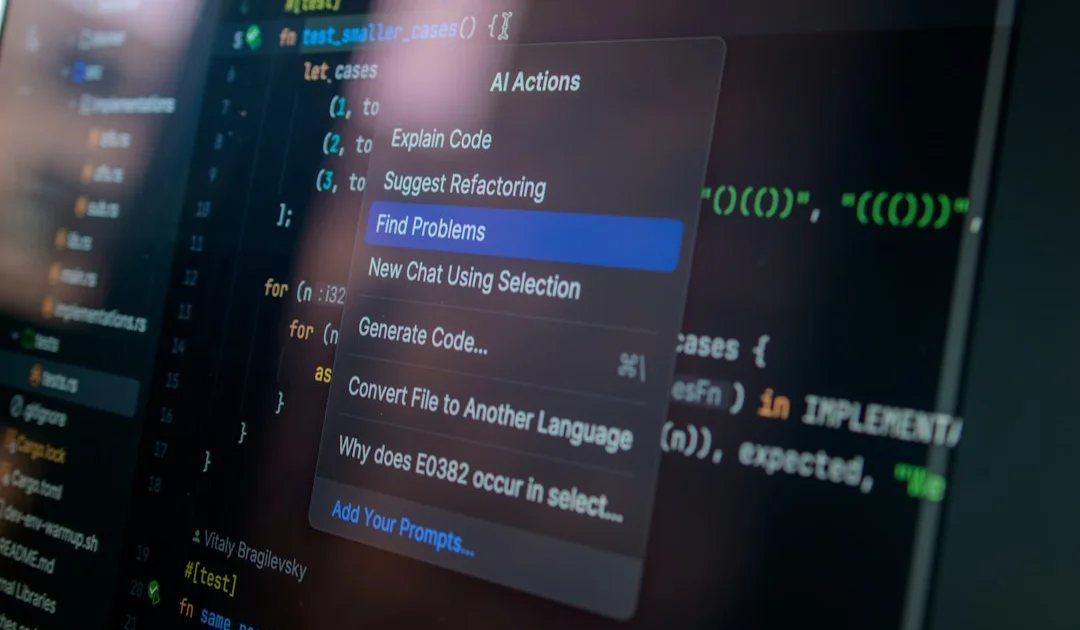

Imagine a world where 75% of all new code at Google is AI-generated, with human engineers primarily reviewing and approving it. That's not a prediction for some distant future; it's our reality as of April 2026. Artificial intelligence isn't just augmenting web development; it's fundamentally reshaping the entire job market, creating a distinct divide between those with specialized skills and those focused on routine tasks.
This seismic shift means the entry-level career ladder looks dramatically different today. What once offered a straightforward path into coding is now a bottleneck, while the demand for seasoned architects, AI integrators, and critical code reviewers is soaring. We're witnessing a profound redefinition of what it means to be a web developer in 2026.
The AI Takeover: Speed, Scale, and the Shifting Ground
AI's presence in web development is undeniable and pervasive. As of October 2026, a staggering 76% of developers use AI tools, with over half, 51%, integrating them into their daily workflow. This widespread adoption isn't just about novelty; it's about raw productivity.
AI tools generate functional code 55% faster, according to industry research. This speed is transforming how quickly projects move from concept to deployment. Companies like Idea Usher are already using AI coding assistants such as GitHub Copilot and proprietary tools to accelerate Minimum Viable Product (MVP) development, showing a clear path for faster innovation.
But this efficiency comes with a trade-off. While AI speeds up code generation, it also drives a 41% rise in code churn. Even more critically, over 40% of AI-generated code carries a hidden vulnerability that requires human review. Veracode's 2025 report further highlighted this, finding that 45% of AI-generated code contained a known security flaw. This data underscores a crucial point: AI is a powerful assistant, but it's not a flawless one.
The "Seniority Trap": Where Did the Junior Roles Go?
The most striking consequence of AI's rise is the structural displacement of entry-level and mid-level roles. Experts call this the "Seniority Trap," a hollowing out of traditional career paths. AI's ability to handle routine syntax, boilerplate generation, and simple feature implementation means junior developers who once focused on these tasks now face diminishing opportunities.
The numbers don't lie. Entry-level tech hiring has dropped sharply since 2022. The share of juniors in IT employment has fallen from 15% to a mere 7% in just three years. Research from Northeastern University in April 2026 quantified a 16.3% drop in junior job vacancies relative to senior roles. The Stanford Digital Economy Lab, using ADP payroll data, found employment in AI-exposed occupations for workers aged 22 to 25 fell 4.3% year-over-year in June 2026, extending a 33-month contraction.
This isn't just a temporary dip; it's a fundamental shift. While IBM announced plans to triple U.S. entry-level hiring in 2026, they noted that junior engineers are shifting from routine coding to customer-facing and judgment work that AI cannot yet handle. This suggests that even new roles for juniors demand a different skillset than before, emphasizing problem-solving over raw coding output.
Beyond Code: The New Core Web Developer Skills for 2026
The web developer role is evolving from a "producer" of raw syntax to a "director" of AI. This means a new set of specialized skills are now critical for success. Gartner predicts that by 2026, 75% of developers will spend more time orchestrating and architecting than writing code directly. This isn't about writing less code; it's about writing higher-value code and ensuring AI-generated code meets rigorous standards.
System Architecture Expertise
Designing the overall technical blueprints for applications, including components, APIs, data flows, scalability patterns, and infrastructure, has never been more important. This includes deep knowledge of cloud platforms like AWS, Google Cloud, and Azure, alongside robust DevOps capabilities involving tools like Docker, Kubernetes, and CI/CD pipelines. Companies like SoftKraft, for example, are combining web development with high-end data science for real-time data visualization, requiring complex architectural planning.
AI Integration Mastery
Developers must master integrating AI into web platforms. This means harnessing Generative AI and Machine Learning models, building smart applications that adapt to user behavior, and ensuring secure backend API design for AI feature queries. Specific skills include LLM integration, Retrieval-Augmented Generation (RAG) pipelines, vector databases, LLMOps, prompt versioning, model evaluation, and agentic workflow orchestration. Unico Connect, for instance, offers expertise in AI agents, RAG pipelines, and LLM integrations.
Critical Code Review and Security
The ability to rigorously audit AI-generated code for security vulnerabilities, performance issues, and logical errors is paramount. With 40% of AI-generated code carrying hidden vulnerabilities, human review is not optional; it's a necessity. Junior developers now need these review skills much earlier in their careers. This focus on quality control and security is creating growing niches in performance and security engineering, which are increasingly in demand.
Prompt Engineering and Product Thinking
Giving AI the right context, persona, and constraints to get usable, accurate code back is a specialized skill. Prompt engineering isn't just about asking questions; it's about crafting precise instructions. Beyond that, developers need to think about the product and business logic, not just the code. They must understand user needs and strategic goals, ensuring AI-generated solutions align with broader business objectives.
The Growing Demand for Specialized Talent
While entry-level roles dwindle, the demand for senior and specialized talent is exploding. Between May 2025 and May 2026, senior roles accounted for 71% of the increase in software hiring. Time-to-hire for senior engineering roles dropped from 47 days to 38 days by Q1 2026, signaling intense competition for top talent. AI-specific job postings grew 74% year-over-year by Q1 2026, with AI, ML, and data roles seeing a massive 163% year-over-year increase by September 2026.
This demand translates into significant compensation. AI/ML engineer salaries have risen to an average of $206,000, up $50,000 in a single year as of June 2026. Robert Half reports starting salaries for AI and ML engineers between $134,000 and $193,250. The fully loaded cost of a senior U.S. engineer passed $200,000 by September 2026, reflecting the high value placed on these specialized skills.
New roles are emerging rapidly, such as AI Automation Engineer, AI Agent Developer, Prompt Engineer, MLOps Engineer, and Forward Deployed Engineer. Companies like Sparkout Tech Solutions Inc. are mastering the integration of Multi-Model AI Agents into web infrastructure, building "thinking" platforms with self-healing backend code and predictive customer journey mapping. This shows the cutting edge of AI web development.
The No-Code Revolution and TashiOS
In this bifurcated market, low-code and no-code platforms are playing an increasingly vital role. The low-code and no-code market is projected to reach $187 billion by 2032. These platforms empower developers to move faster, abstract away boilerplate, and focus on the higher-level architecture and AI integration that truly differentiate applications.
Platforms like TashiOS exemplify this shift. TashiOS is an AI-powered operating system where you can describe your ideas in plain English and build real apps, websites, online stores, and Android apps with no code. It allows developers to offload routine implementation, freeing them to concentrate on the complex AI integrations, system design, and critical review tasks that demand human expertise. This isn't just for non-developers; it's a powerful tool for experienced engineers to accelerate their work and focus on innovation.
Navigating the New Era: Upskilling for Success
The message is clear: adaptation is not optional. Developers must embrace upskilling and reskilling to thrive in this new environment. Learning to use AI coding tools effectively, understanding their strengths and limitations, and developing a critical eye for AI-generated output are now core competencies.
The focus shifts from being a code "producer" to a code "director." This means understanding how to prompt AI effectively, how to integrate AI models, and how to rigorously review the output for security, performance, and alignment with business logic. A UC Berkeley and Yale study in early 2026 even found that when companies replace junior developers with AI, senior engineers experience task expansion and increased review burden, leading to burnout. This highlights the need for all developers to adapt, not just those at the entry-level.
The U.S. Bureau of Labor Statistics still projects a 16% job growth for web developers over the next decade as of August 2026, faster than the average for all occupations. However, this growth isn't uniform. It's concentrated at the senior, specialized end of the spectrum. The future of web development jobs is bright, but it demands a different kind of developer.
The web development landscape of 2026 is defined by a "barbell" effect: heavy demand for experienced engineers, a thick stack of junior applicants, and a thin, fought-over middle of senior talent. The ones who will truly succeed are those who embrace AI as a partner, not a competitor, and who cultivate the specialized skills that AI can't yet replicate: strategic thinking, architectural design, critical review, and deep understanding of business context.
Ready to build the future of web development? Explore how TashiOS can help you bring your ideas to life with AI, no code required. Start free with AI credits today and focus on the strategic innovation that truly matters.